
SINP 2026 Allocation Update: Saskatchewan Uses 26% of its PNP Quota
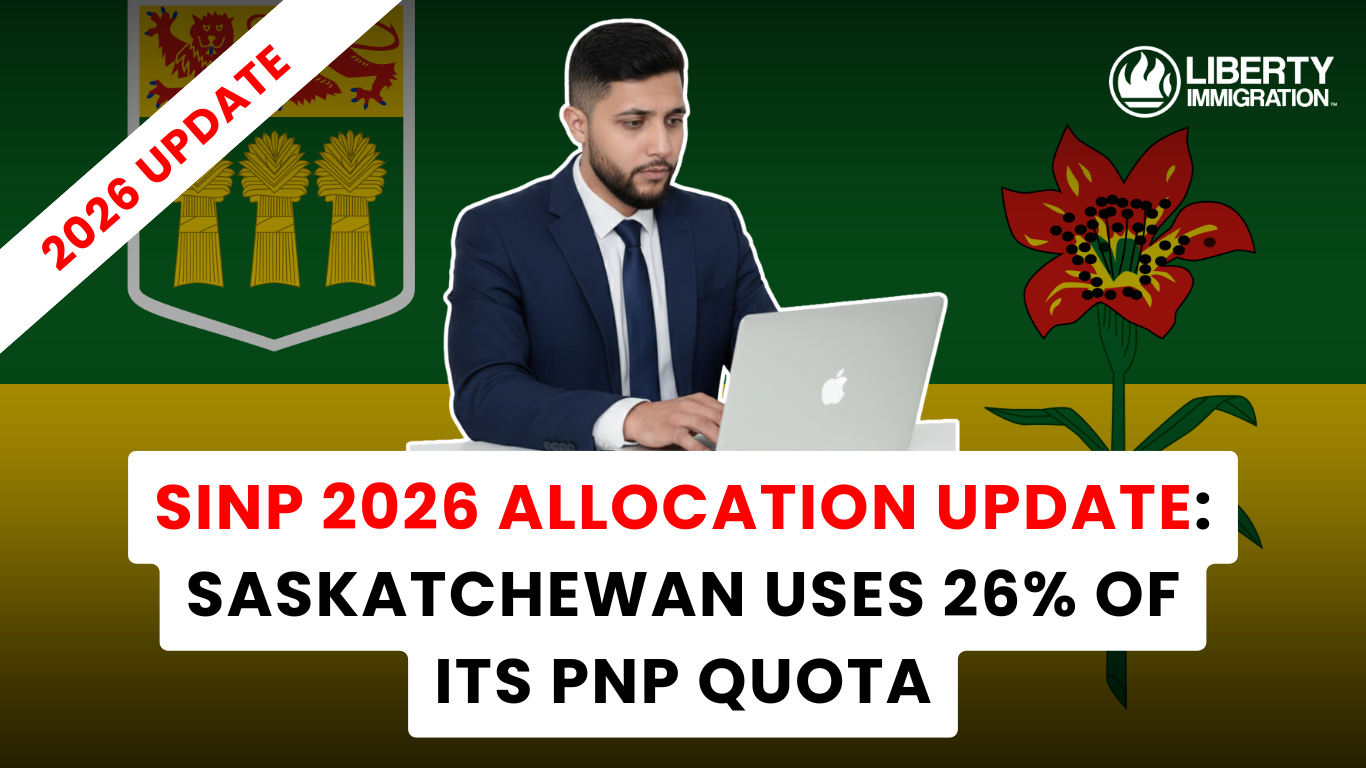
Executive Summary: Q1 Saskatchewan Data Released
Hello! I am RCIC Vineet. The Government of Saskatchewan has just released its highly anticipated quarterly data for the SINP 2026 allocation. If you are aiming for permanent residence in the prairies, you must understand exactly how fast these quotas are filling up.
- The Total Allocation: Saskatchewan was granted 4,761 nominations for 2026. As of late April, the province has already issued 1,223 nominations (using roughly 26% of its total quota).
- Priority Sectors Dominating: The 7 Priority Sectors (including Healthcare, Tech, and Trades) have issued 689 nominations, representing 29% of their massive 2,380 allocated spots.
- The May 4th Deadline: If you work in a capped sector (Retail, Trucking, Hospitality), the next intake window opens on May 4. Spots are strictly first-come, first-served.
- Remaining Spots: The SINP still has 3,538 available nominations for the remainder of the year.
SINP 2026 Allocation: Saskatchewan Issues Over 1,200 Nominations in Q1
Unlike other Canadian provinces that publish the results of their Expression of Interest (EOI) draws on a bi-weekly basis, Saskatchewan operates differently. The province manages its highly competitive Saskatchewan Immigrant Nominee Program (SINP) by quietly processing applications and releasing massive data dumps on a quarterly basis.
For candidates navigating the complex waters of Canadian immigration, the latest data regarding the SINP 2026 allocation is critical. The province has officially announced that it has issued approximately 26% of its allotted nominations for the year. Out of the 4,761 total nominations granted by the federal government, 1,223 have already been secured by skilled workers and international graduates.
As a Regulated Canadian Immigration Consultant (RCIC), I closely monitor these quotas. Why? Because Saskatchewan heavily restricts certain industries. If you are in a "capped sector," knowing how many spots are left is the difference between securing PR and losing your status in Canada. Here is the complete breakdown of the SINP 2026 allocation data.
Is Your Sector Filling Up? Book an Urgent SINP Strategy Session1. The Complete Breakdown: How Many Nominations Have Been Issued?
To manage demand and maintain a balanced local labor market, Saskatchewan categorized all 4,761 of its nominations into three distinct buckets for 2026:
- Priority Sectors: 2,380 spots allocated (50% of the total quota).
- Capped Sectors: 1,190 spots allocated (25% of the total quota).
- Other Sectors: 1,190 spots allocated (25% of the total quota).
Here is exactly how many nominations the province has issued to date under each specific sector:
| Sector Category | Nominations Issued So Far | Total 2026 Allocation (By Sector) |
|---|---|---|
| Priority Sectors | 689 | 50% |
| Capped Sector: Accommodation & Food Services | 188 | 15% |
| Capped Sector: Retail, Trade, and Other Services | 74 | 5% |
| Capped Sector: Trucking | 46 | 5% |
| Other Sectors | 226 | 25% |
2. Percentage of the SINP 2026 Allocation Used to Date
Looking at raw numbers only tells half the story. You must look at the percentage of the quota that has already been burned through. If you are in Retail, for example, your quota is burning much faster than the Trucking sector.
| Sector | Total Allotted Spots for 2026 | Percentage of Quota Used to Date |
|---|---|---|
| Priority Sectors | 2,380 | 29% |
| Capped Sector: Accommodation & Food Services | 714 | 26% |
| Capped Sector: Retail, Trade, and Other Services | 238 | 31% |
| Capped Sector: Trucking | 238 | 19% |
| Other Sectors | 1,190 | 19% |
The Priority Sectors include Healthcare, Agriculture, Skilled Trades, Mining, Manufacturing, Energy, and Technology. Within this massive 2,380 allocation, Saskatchewan is explicitly reserving 750 slots for graduates of Saskatchewan-based Designated Learning Institutions (DLIs) who secure employment in one of these priority occupations.
3. The 6-Month Rule and Upcoming Intake Windows
If you fall into the "Other Sectors" or the "Priority Sectors," you have a distinct advantage: there are no restrictions in place regarding when your employer can submit an application. You can apply at any time until the quota runs out.
However, if you fall into one of the three Capped Sectors (Hospitality, Retail, or Trucking), the rules are brutally strict to manage the SINP 2026 allocation.
Employers of workers in these capped sectors can only submit an application if the foreign worker's current Canadian work permit is valid for six months or less. Furthermore, they can only apply during specific, scheduled "Intake Windows." These spots are made available on a strict first-come, first-served basis, and the portal frequently crashes due to overwhelming demand.
The 2026 Capped Sector Intake Schedule:
- Intake 1: January 20 (Closed)
- Intake 2: March 2 (Closed)
- Intake 3: May 4
- Opens at 8:30 a.m. CST for Trucking & Retail/Trade sectors.
- Opens at 12:30 p.m. CST for Accommodation & Food Services.
- Intake 4: July 6
- Intake 5: September 7
- Intake 6: November 2
Are You Prepared for the May 4th Intake?
If your work permit expires soon and you are in a Capped Sector, missing an intake window is disastrous. Let our licensed RCIC team prepare and submit your application the second the portal opens.
Secure Your Spot with an RCIC TodayTop 20 FAQs: Understanding the SINP 2026 Allocation
With 3,538 available nominations remaining for the year, candidates must be strategic. Here are the 20 most frequently asked questions regarding the SINP 2026 allocation data and rules.
1. What is the total SINP 2026 allocation?
The federal government allocated Saskatchewan a total of 4,761 nominations for the 2026 calendar year across all streams.
2. How much of the SINP 2026 allocation has been used?
As of late April 2026, Saskatchewan has issued 1,223 nominations, which accounts for approximately 26% of its yearly quota.
3. How many spots are left in the SINP for 2026?
The province currently has 3,538 available nominations remaining for distribution throughout the rest of 2026.
4. What are the SINP Priority Sectors?
The 7 Priority Sectors are Healthcare, Agriculture, Skilled Trades, Mining, Manufacturing, Energy, and Technology. These sectors are allocated 50% of all nominations (2,380 spots).
5. What are the SINP Capped Sectors?
Capped sectors include Accommodation and Food Services (15%), Retail, Trade, and other services (5%), and Trucking (5%). They are strictly limited to manage labor market balance.
6. How many nominations have been issued to Retail workers so far?
74 nominations have been issued in the Retail/Trade sector, which represents 31% of its 238-spot allocation for 2026.
7. What is the 6-month work permit rule?
If you work in a Capped Sector, your employer can only submit a nomination application if your current Canadian work permit is valid for six months or less.
8. When is the next intake window for capped sectors?
The next intake window opens on May 4, 2026. Trucking and Retail open at 8:30 a.m. CST, while Accommodation and Food Services open at 12:30 p.m. CST.
9. Do priority sectors have intake windows?
No. Employers of candidates in Priority Sectors and 'Other Sectors' face no time restrictions and can submit applications year-round until the quota is filled.
10. How often does Saskatchewan publish draw data?
Unlike other provinces that publish bi-weekly draw results, Saskatchewan typically updates its nomination distribution figures on a quarterly basis.
11. Are international students included in the SINP 2026 allocation?
Yes. Within the Priority Sector allocation, exactly 750 spots are explicitly reserved for graduates of Saskatchewan-based Designated Learning Institutions (DLIs).
12. What does "Other Sectors" mean?
Other Sectors (allocated 25% of the quota) cover any industry that is not explicitly defined as a Priority Sector or a Capped Sector, such as finance, real estate, and general administration.
13. Can I apply for a Capped Sector from overseas?
No. Because of the rule requiring an existing work permit that expires within 6 months, overseas applicants are effectively barred from applying to Capped Sectors in 2026.
14. How many spots are left for Accommodation and Food Services?
The sector was allocated 714 spots. With 188 issued, there are 526 spots remaining for the rest of 2026 across the final 4 intake windows.
15. Is it first-come, first-served for Capped Sectors?
Yes. When an intake window opens (like on May 4), applications are accepted on a strict first-come, first-served basis until the limit for that specific window is reached.
16. What happens if the SINP 2026 allocation runs out?
Once the 4,761 nominations are exhausted, the SINP will cease issuing nominations until the federal government issues a new allocation quota for the 2027 calendar year.
17. Is the tech sector capped in Saskatchewan?
No. The Technology sector is classified as a Priority Sector. It draws from the massive 2,380-spot allocation and is not subject to intake windows.
18. Do I need an Express Entry profile to get nominated?
It depends on the sub-category you apply under. You can apply through the Express Entry linked stream, or through base PNP streams (like Occupations In-Demand) which do not require a federal profile.
19. How many intake windows are left in 2026?
There are four remaining intake windows for capped sectors in 2026: May 4, July 6, September 7, and November 2.
20. Should I hire an RCIC for the May 4th intake window?
Yes. Because capped sector intake windows fill up incredibly fast on a first-come, first-served basis, having an RCIC ensure your paperwork is flawless and submitted immediately is critical for success.
Trending 2026 Provincial Nominee Updates
- New Brunswick issues more than 140 invitations across Express Entry and AIP draws
- Newfoundland and Labrador holds third provincial immigration selection round of 2026
- Manitoba expands work permit access for rural employers and workers under TFWP measures
- British Columbia holds April draw, issues invitations to entrepreneurs
© 2026 Liberty Immigration. All rights reserved. | Book a Consultation
Related Blogs:


Written By
Vineet Tiwari
Vineet is a caring and creative leader who has lived in India, Oman, UAE, and Canada, giving him a rich multicultural perspective. His commitment to physical fitness keeps him energetic and focused. Vineet's dedication to his clients is evident as he often takes calls on weekends, ensuring they always feel supported and valued. His diverse background and unwavering availability help build strong, trusting relationships with our clients.