
Pete Hoekstra & the USMCA Review: Shifting Rules for Cross-Border Work Permits
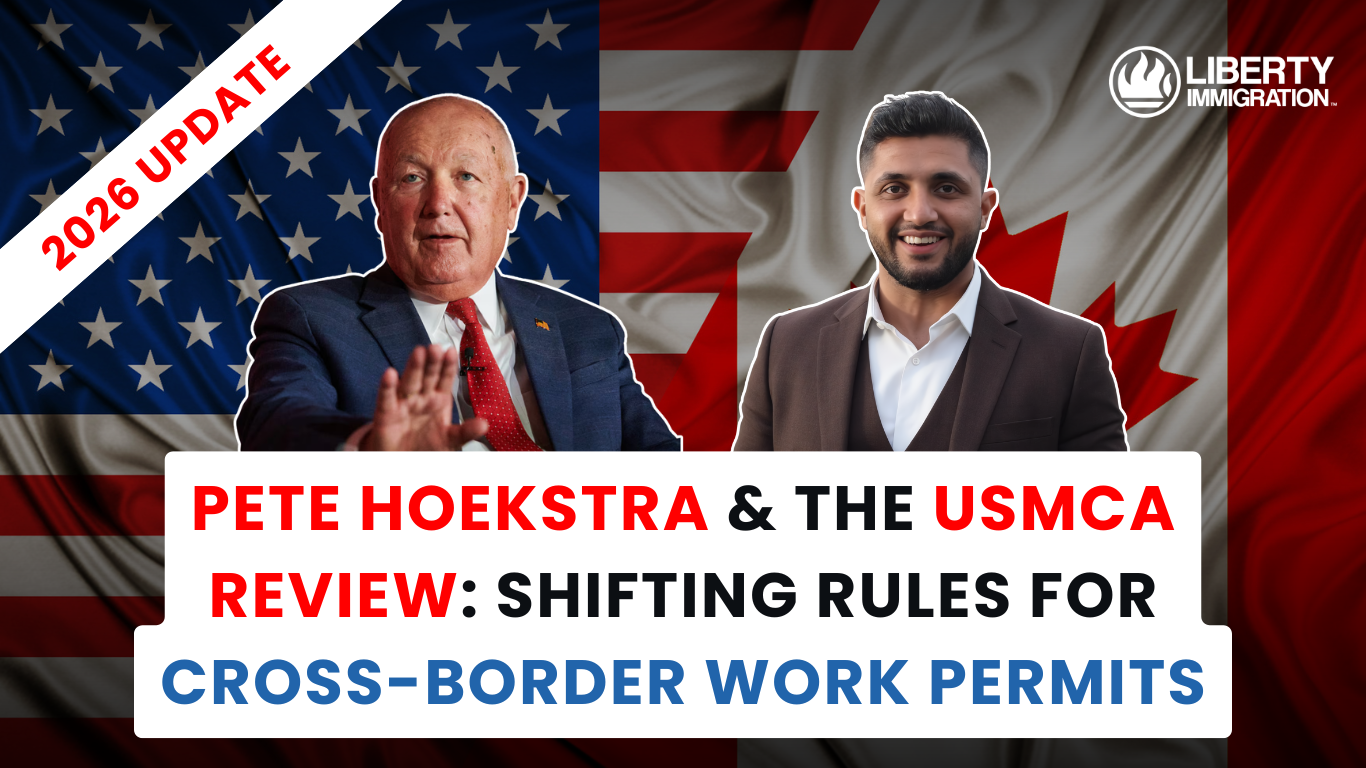
Executive Summary: Navigating Border Policy Brinkmanship
The regulatory foundation governing continental corporate mobility faces structural adjustments following a high-stakes trade policy development. Sourcing active intelligence from the U.S.-Canada Summit in Toronto reveals a major pivot in how cross-border corporate portfolios must evaluate future file stability. To shield multi-jurisdictional teams from unexpected entry disruptions, corporate planners must adapt to these active parameters involving Pete Hoekstra and upcoming treaty parameters:
- **The Negotiation Mandate:** Striking a starkly different tone from the White House, U.S. Ambassador Pete Hoekstra confirmed that the administration's tariff rhetoric is a calculated invitation for Canada to "make us an offer".
- **Work Permit Channels Vulnerable:** While physical commodities like automotive parts, oil, and potash dominate media focus, the legal framework shielding cross-border work permits from standard advertisement thresholds remains a central piece of the bargaining grid.
- **LMIA-Exempt Protections Intact:** For the current cycle, CUSMA/USMCA mechanisms remain fully active, protecting valid intra-company transfers and professional visa classes from general border tariffs.
- **Immediate Profile Mitigation:** Multi-national entities are actively urged to execute long-term mobility filings aggressively ahead of the upcoming statutory sunset and review windows.
Pete Hoekstra & the USMCA Review: Shifting Rules for Cross-Border Work Permits
For corporate HR directors, international legal teams, and specialized professionals moving across the 49th parallel, continental trade agreements provide a vital legal foundation. The Canada-United States-Mexico Agreement (known as CUSMA in Canada and USMCA in the United States) does far more than just shield cross-border supply chains from commercial import tariffs; it serves as the absolute legal framework enabling seamless, frictionless executive and professional mobility across North America.
However, that baseline of operational predictability has shifted into an era of high-stakes trade diplomacy. Sourcing official briefings from the high-profile U.S.-Canada Summit in Toronto, the current cross-border dialogue has taken an aggressive turn. Following blunt statements from President Donald Trump suggesting his administration is "not looking to renew" the trilateral pact ahead of the critical joint review window, U.S. Ambassador Pete Hoekstra stepped forward to provide an essential interpretive gloss for North American business leaders.
As a leading cross-border corporate strategy firm, we perform comprehensive portfolio audits to protect international teams from entry-point friction. Successfully navigating this diplomatic environment requires looking past the surface-level rhetoric and focusing directly on the underlying mechanics of treaty negotiations. Below is your definitive operational manual tracking the upcoming USMCA review, Ambassador Hoekstra's strategic guidance, and the immediate steps required to shield your corporate mobility tracks.
Are Your Continental Intra-Company Transfers Documented for Upcoming Audits? Schedule an Expert Consultation1. The "Make Your Case" Directive: Reframing the White House Stance
The corporate anxiety building across North American boardroom networks peaked after the White House issued a blunt warning declaring that the United States has zero structural reliance on northern commodities and would consider letting the trilateral agreement expire. However, speaking directly to an elite business audience at the Eurasia Group summit in Toronto, Ambassador Pete Hoekstra significantly reframed the president's blunt position.
Characterizing the administration's stance as a classic business-first negotiating posture rather than an outright policy rejection, Hoekstra explained that the blunt rhetoric is a clear signal that the U.S. is fully open for business and looking for strategic proposals. He explicitly urged Canadian trade officials and prime minister Mark Carney's newly minted cabinet to drop defensive posturing, don a "sales hat," and go into upcoming negotiations with aggressive confidence.
Ambassador Pete Hoekstra's Toronto Mandate:
"When the president says 'we don't need anything that Canada has'—America actually has a tremendous amount of structural needs across the board. You may not like the specific way the president packages his words, but what he is fundamentally communicating is: 'We are open to offers; step forward and make your case.' Go into these negotiations very aggressively and explicitly prove why Canada is the safest, most logical partner to fill those gaps."
This tactical directive indicates that behind-the-scenes trade channels are highly active. However, while public trade ministers debate sectors like Ontario-built automobiles, Alberta crude oil, and Saskatchewan potash, corporate legal advisors must focus intensely on the upcoming shifts targeting Chapter 16—the engine that powers international professional mobility.
2. The Corporate Mobility Risk: Shifting Cross-Border Work Permits
The primary value that a valid CUSMA/USMCA framework provides to multinational corporations is the complete exemption from standard domestic labor market test protocols. Under standard immigration criteria, bringing an international hire into Canada or the U.S. requires navigating a lengthy, expensive Labour Market Impact Assessment (LMIA) or U.S. labor certification process where a company must explicitly prove that no native worker is available to fill the role.
Chapter 16 entirely bypasses this regulatory gridlock for North American citizens. If the trilateral agreement faces aggressive changes or structural delays during the upcoming **USMCA review**, these frictionless mobility options stand in immediate jeopardy.
Review the comprehensive strategic matrix detailing how different corporate visa tracks are exposed to the active treaty renegotiation timelines:
| Cross-Border Corporate Visa Pathway Track | Active Treaty Protection State (2026 Baseline) | Anticipated Post-Review Modification Risks |
|---|---|---|
| CUSMA Professional Visas (Professionals Stream) | Fully Functional / Non-LMIA Ingestion | Potential narrowing of eligible professional titles; addition of localized wage-floor controls or annual caps. |
| Intra-Company Transfers (ICT Executive Class) | Fully Functional / Streamlined Border Processing | Increased scrutiny regarding "specialized knowledge" criteria; mandatory pre-arrival registry audits. |
| CUSMA Investors & Traders (E-Visas) | Active with Substantial Capital Commitments | Tightening of required regional content values and domestic ownership thresholds. |
| Standard Corporate LMIAs (Non-Treaty Path) | Highly Restrictive / Subject to Labor Market Tests | Serves as the baseline safety net if treaty rules stall; adds 3 to 6 months of mandatory local advertising delays. |
3. The Strategic Action Plan: Protecting Your Multi-National Talent Grid
With Ambassador Hoekstra confirming that the White House views the upcoming treaty deadline as a leverage point, corporations cannot afford a passive "wait-and-see" compliance strategy. Protecting your cross-border engineering teams, executive assets, and technical managers requires executing immediate risk-mitigation measures:
Do not wait for the formal completion of the USMCA review to renew expiring cross-border work permits. For any core executive or specialized technician currently operating under a temporary CUSMA professional status, companies are strongly advised to execute multi-year extension applications immediately. Securing a long-term status stamp under active 2026 parameters locks in your team's legal authorization, shielding them from sudden policy shifts at the border.
- **Audit "Specialized Knowledge" Documentation:** Border officers are applying increased scrutiny to Intra-Company Transfer (ICT) portfolios. Ensure your company reference letters explicitly document proprietary technologies or specialized corporate operational models to survive strict entry evaluations.
- **Leverage Parallel Non-Treaty Pathways:** As a strategic backup, work with your legal counsel to map out parallel non-CUSMA streams. Identifying applicable provincial nominee routes or federal fast-track global talent streams ensures your business continuity remains fully protected if trade negotiations drag out.
Shield Your Cross-Border Workforce from Trade-Draw Shocks
With President Trump questioning the future of trilateral trade pacts and Ambassador Pete Hoekstra confirming that the administration expects aggressive corporate counter-offers, letting your international transfers run un-audited introduces clear operational risks. Let our expert team check your cross-border work permits, optimize your CUSMA professional portfolios, and secure your long-term team continuity safely.
Book Your Strategic Corporate Mobility Audit NowTop 5 FAQs: Navigating Pete Hoekstra's Trade Directives
1. What did U.S. Ambassador Pete Hoekstra say about the future of the CUSMA/USMCA treaty?
Speaking at the Toronto U.S.-Canada Summit, Ambassador Hoekstra reframed the president's hard-line statements as a standard business negotiating posture. He stated that the U.S. administration is "open to offers" and urged Canadian officials to aggressively make their case for partnership.
2. How do these trade negotiations directly impact cross-border work permits?
The CUSMA/USMCA treaty provides the legal foundation for Chapter 16, which allows citizens of the U.S., Canada, and Mexico to secure professional and intra-company work permits without undergoing lengthy and restrictive domestic labor market tests (LMIAs).
3. Is Donald Trump planning to immediately tear up the trade agreement?
While the president has used sharp rhetoric and trolled the Canadian economy online, statements from ambassador Hoekstra and other top administration officials indicate that a total termination is highly unlikely. Instead, the blunt language is being utilized as maximum leverage to extract deeper concessions during the upcoming review cycle.
4. Can a company still apply for a new Intra-Company Transfer (ICT) visa under active 2026 rules?
Yes. The trilateral agreement remains fully functional and legally binding. All standard port-of-entry processing channels for professional and executive transfers are operating under normal guidelines, though officers are applying tighter scrutiny to specialized documentation.
5. What happens to active corporate work permits if the treaty enters a prolonged renegotiation phase?
As long as the treaty remains active and has not been formally terminated via a six-month notice window, all existing cross-border work permits remain fully valid. However, smart companies are executing multi-year extensions early to insulate their teams from sudden rule changes.
More in Entry Controls, Express Entry Strategies & Corporate Mobility Management
- IRCC Processing Updates: Reviewing the Latest 2026 Drop Metrics Across Permanent Selection Pools
- The High-Wage Factor: Discover How Imminent CRS Scoring Adjustments Impact Corporate Professionals
- Quebec PEQ Overhaul: MIFI Confirms July Launch for Flagship Experience Program Re-Opening
- RCIC Portal Access: Order a Strategic Continental Personnel Performance Audit with Our Team
© 2026 Liberty Immigration. All rights reserved. | Book an RCIC Consultation
Related Blogs:


Written By
Vineet Tiwari
Vineet is a caring and creative leader who has lived in India, Oman, UAE, and Canada, giving him a rich multicultural perspective. His commitment to physical fitness keeps him energetic and focused. Vineet's dedication to his clients is evident as he often takes calls on weekends, ensuring they always feel supported and valued. His diverse background and unwavering availability help build strong, trusting relationships with our clients.
