
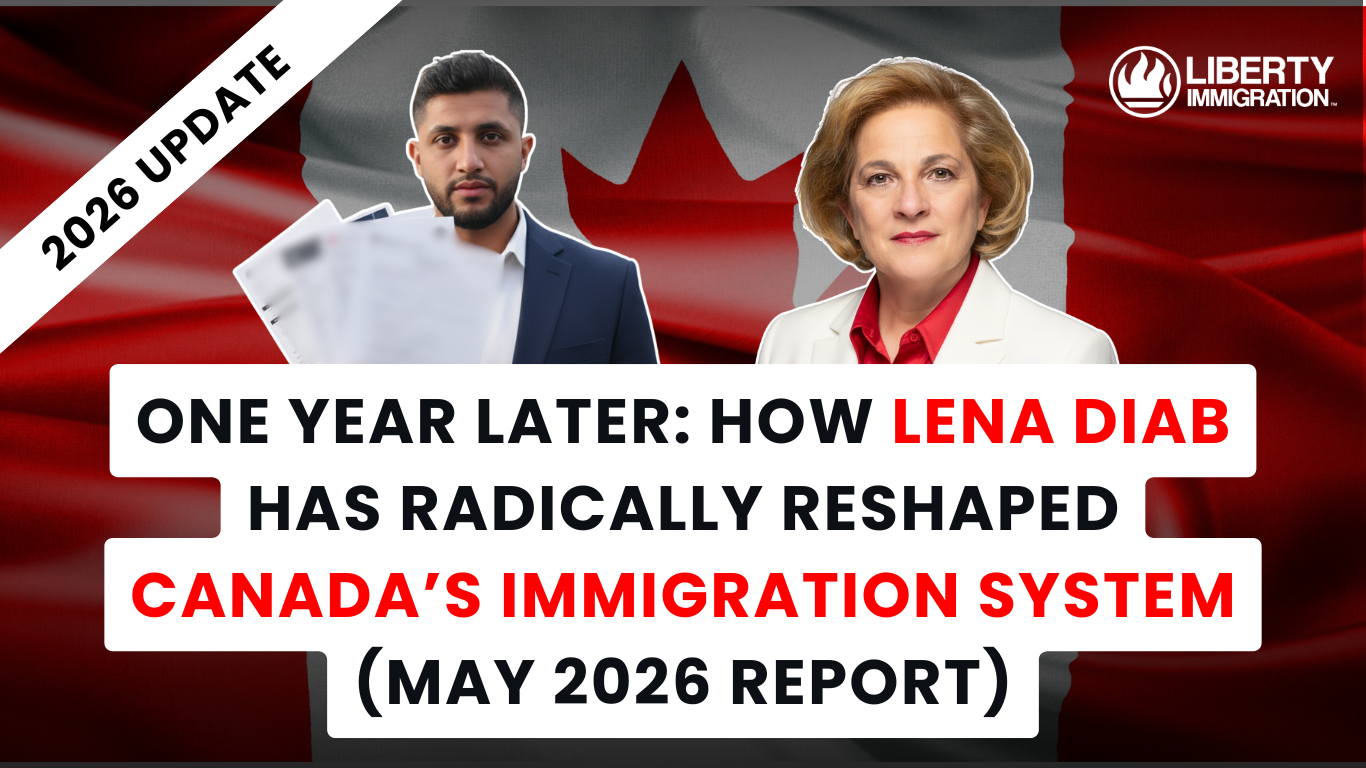
ONE YEAR LATER: How Lena Diab Has Radically Reshaped Canada’s Immigration System (May 2026 Report)
Executive Summary: The Diab Era Mandate
Marking exactly one year since her high-profile appointment on May 13, 2025, Immigration Minister Lena Metlege Diab has completely overhauled Canada’s temporary and permanent migration architecture. Working under Prime Minister Mark Carney, Minister Diab has implemented policies focused on shifting power away from centralized channels toward regional, occupational, and strict enforcement mechanisms. RCIC Vineet provides a comprehensive review of the current structural data landscape.
- Decentralization Paradigm: The 2026 Levels Plan cut federal permanent residence allocations while increasing Provincial Nominee Program (PNP) baseline admission thresholds by 66%.
- Surgical Express Entry Draws: Five highly targeted occupational categories were introduced, focusing on surgical economic draws over general pools.
- In-Canada Workers Initiative: A strategic pathway designed to transition 33,000 rural temporary workers to Permanent Residency throughout 2026 and 2027.
- Administrative Easing: Removed co-op work permits and PAL requirements for graduate students to optimize the Processing Queue.
- Enforcement Overhaul: The implementation of Bill C-12 has introduced strict asylum timelines and granted sweeping discretionary closure powers to the Governor in Council.
ONE YEAR LATER: How Lena Diab Has Radically Reshaped Canada’s Immigration System
May 2026 marks the first full year of tenure for Lena Metlege Diab as Canada’s Minister of Immigration, Refugees and Citizenship. Taking office on May 13, 2025, during an era of significant public scrutiny regarding macro-inventory volumes, Minister Diab has guided a structural transformation of the system. In close alignment with Prime Minister Mark Carney, the ministry has adjusted the federal framework to prioritize three key pillars: localized economic selection, streamlined international student pathways, and stricter enforcement measures.
This operational trajectory represents a notable shift from the policies of the previous Justin Trudeau and Marc Miller administrations. Instead of prioritizing high-volume, centralized intakes, the application of current Lena Diab immigration policies Canada protocols focuses on matching economic newcomers directly with specific regional labor shortages and enforcing strict regulatory compliance.
As a Regulated Canadian Immigration Consultant (RCIC), I am continuously evaluating how these structural updates alter candidate positioning in the pool. Below is an exhaustive analytical review tracking the systemic adjustments introduced across the permanent, temporary, and humanitarian classes over the past twelve months.
Is Your Profile Strategy 2026 Compliant? Schedule a Professional Consultation Now1. Regional Decentralization: Shifting Power to the Provinces
The first major structural adjustment executed under Minister Diab was a significant reorganization of permanent residence levels. In an intentional departure from previous targets, the ministry introduced a substantial 66% expansion to provincial selection limits, raising the annual admissions target to 91,500 for 2026, compared to the 55,000 baseline cap maintained under Miller.
To balance this provincial expansion, the federal government reduced top-level centralized allocations for the first time in nearly a decade. The standalone federal Express Entry baseline target dropped to 109,000 admissions for 2026, down from the 124,680 target initially projected for 2025. However, the overarching commitment to economic immigration remained high, with total combined economic targets climbing from 232,150 to 239,800 across the current calendar cycle.
| Immigration Level Pathway Category | Former Baseline Allocation (Miller Era) | Current 2026 Admission Targets (Diab Era) | Net Structural Policy Shift Percentage |
|---|---|---|---|
| Provincial Nominee Program (PNP) | 55,000 | 91,500 admissions target | + 66% Allocation Increase |
| Federal Centralized Pathways (Express Entry) | 124,680 (2025 Target) | 109,000 admissions target | - 12.5% Allocation Reduction |
| Total Overarching Economic Admissions | 232,150 | 239,800 target | + 3.3% Marginal Shift |
This shift allows individual provinces to customize their nomination streams to address local labor gaps. For example, British Columbia adjusted its strategy by allocating nearly its entire 2026 nomination quota to healthcare practitioners, skilled tradespeople, entrepreneurs, and high economic impact candidates, moving away from more generic applicant selections.
2. Deep Dive: The In-Canada Workers Initiative
A key focus of current Lena Diab immigration policies Canada frameworks is the economic integration of rural labor markets. This focus centers on the *In-Canada Workers Initiative*, a temporary program designed to transition 33,000 active temporary foreign workers to Permanent Resident status over a multi-year horizon.
Initially introduced in Budget 2025 last November and confirmed in the annual Levels Plan, the program became a subject of discussion following a March 2026 interview with the *Toronto Star*, where Minister Diab confirmed the initiative had officially launched without previously specifying the precise selection criteria. Clarifying details emerged during a mid-April interview with "I'm Canada," where Diab explicitly stated that the pathway would entirely exclude temporary workers residing within major urban metropolitan centers.
The definitive framework, released on May 4, 2026, established that candidates must demonstrate at least two years of continuous residency within a designated smaller or rural community to qualify. The program operates primarily by accelerating processing for eligible work permit holders already in the inventory of streams like the PNP or the Atlantic Immigration Program (AIP). The ministry aims to transition 20,000 workers during 2026—having already achieved 3,600 transitions across January and February alone—with the remaining 13,000 allocations reserved for 2027.
To assist rural businesses, the ministry introduced temporary measures under the Low-Wage stream of the Temporary Foreign Worker Program (TFWP). Effective from April 1, 2026, to March 31, 2027, participating rural employers across British Columbia, Manitoba, New Brunswick, Nova Scotia, and Quebec can fill up to 15% of their total workforce through low-wage streams, up from the standard 10% cap.
3. Express Entry Specialization: Transitioning to Niche Selection
Under Minister Diab's direction, the federal Express Entry framework has moved toward highly specific targeting. The ministry has introduced five specialized selection categories designed to address specific labor requirements through targeted draws:
- Physicians possessing verifiable Canadian medical work history (391 invitations issued to date).
- Senior managers holding verified Canadian professional background (250 invitations issued to date).
- Researchers with established Canadian work history.
- Transport sector specialists.
- Skilled military recruits.
These specialized categories are characterized by a narrow focus, typically containing four or fewer eligible occupations. This contrasts sharply with legacy categories like Trades (25 occupations), STEM (11 occupations), and general Healthcare and Social Services (37 occupations). This approach allows IRCC to conduct smaller, focused draws to address specific labor market requirements without inflating general pool scores. For context, general Canadian Experience Class (CEC) draws continue to issue between 2,000 and 8,000 invitations per round over the course of 2026.
Simultaneously, the baseline qualifications for category-based selection were increased: candidates now require a minimum of one year of cumulative, non-continuous work experience within an eligible NOC code over the past three years, an increase from the previous six-month continuous experience standard.
4. Temporary Residence: Streamlining and Extension Protocols
In addition to permanent residence adjustments, the past year saw significant updates aimed at reducing temporary resident processing backlogs:
- Graduate Cap Exemptions: Effective January 2026, IRCC removed the requirement to obtain a Provincial or Territorial Attestation Letter (PAL/TAL) for incoming Master's and PhD applicants, while introducing an expedited 2-week priority processing queue for doctoral students.
- Co-op Work Permit Simplification: Launched in April 2026, international students enrolled in post-secondary programs featuring integrated internships or practicums are no longer required to apply for a separate co-op work permit. Authorization is now bundled directly into a standard study permit with active on-campus work conditions.
- Maintained Status Extensions: To support applicants facing long in-Canada processing times (which frequently exceed 200 days), IRCC extended the validity of **WP-EXT letters from 180 days to 365 days**, reducing the administrative need to issue secondary bridge authorizations.
- Humanitarian Extensions: The ministry extended open work permit renewal provisions until March 2027 for Iranian nationals holding temporary status inside Canada, as well as Ukrainian evacuees and their family relations previously accommodated under emergency public policies.
5. Stricter Border Control: Enacting Bill C-12
The legislative cornerstone of Minister Diab’s first year was the formal enactment of **Bill C-12**, which implemented a more restrictive approach to asylum processing. The bill introduced a mandatory one-year filing limit, rendering any refugee claim ineligible for an Immigration and Refugee Board (IRB) referral if submitted more than 12 months after the claimant's initial entry into Canada.
Additionally, Bill C-12 requires the IRB to terminate consideration of any pending asylum file if the claimant voluntarily exits Canada and returns to the nation from which they initially claimed fear of persecution. The legislation also grants sweeping discretionary powers to the Governor in Council, allowing the executive branch to immediately halt the intake of designated application streams, pause or terminate active processing queues, vary existing permit parameters, and impose strict conditions on temporary residents.
These measures follow heightened scrutiny regarding system integrity. On March 23, 2026, an Auditor General report revealed that over **153,000 study permits were flagged for potential fraud** between 2023 and 2024. Under the pre-Bill C-12 framework, enforcement staff possessed the operational capacity to investigate fewer than 4,000 files annually.
6. Under Consultation: The Forward Regulatory Plan (2026–2028)
Looking ahead, IRCC’s recently published Forward Regulatory Plan outlines proposals for a substantial restructuring of the economic immigration system. The core proposal involves merging the three existing federal Express Entry streams into a single program with a standardized entry threshold.
This proposed unified program would require all candidates to possess a minimum of a high school diploma, achieve a Canadian Language Benchmark (CLB) score of 6 across all four language competencies, and show at least one year of cumulative work experience within the past three years. Additionally, the plan outlines significant changes to the Comprehensive Ranking System (CRS) scoring structure, including prioritizing candidates in high-wage occupations with extra CRS points, returning dedicated job offer points strictly for high-wage positions, and adjusting or removing several legacy human capital scoring factors.
Align Your Profile with the 2026 Mandates
From the implementation of Bill C-12 to the transition toward targeted Express Entry categories, Canada's immigration rules have changed significantly over the past year. In an era that increasingly rewards high-wage positions, professional qualifications, and regional settlement histories, a strategic approach is essential. Let our professional team, led by RCIC Vineet, audit your credentials and manage your application process safely.
Book Your Strategic Immigration Profile AssessmentTop 5 FAQs: Assessing Lena Diab’s 2026 IRCC Policies
1. How have Express Entry draws changed under Lena Diab’s policies?
Draws have become significantly more targeted. The ministry introduced five specialized categories focusing on narrow occupational profiles, such as physicians and senior managers with Canadian experience. These categories feature smaller, surgical selections compared to general Canadian Experience Class (CEC) draws, which continue to issue between 2,000 and 8,000 invitations per round in 2026.
2. Who qualifies for permanent residence under the In-Canada Workers Initiative?
The initiative aims to transition 33,000 temporary workers to Permanent Resident status across 2026 and 2027. To qualify, candidates must demonstrate at least two years of continuous residency within a smaller or rural community, effectively excluding temporary workers living within major urban areas. The program prioritizes eligible applicants already in the PNP and AIP inventories.
3. What is the one-year asylum rule introduced under Bill C-12?
Bill C-12 introduced a strict statutory timeline stating that any refugee protection claim submitted more than one year after the claimant's initial entry into Canada is ruled ineligible for referral to the Immigration and Refugee Board (IRB).
4. How have international student work rules been simplified in 2026?
In April 2026, IRCC eliminated the requirement for international students to secure a separate co-op work permit to participate in mandatory internships or practicums. Authorization is now integrated directly into a standard study permit featuring active on-campus work conditions. Additionally, Master's and PhD students are exempt from general study permit caps.
5. What changes are proposed for the Express Entry selection model after 2026?
The Forward Regulatory Plan proposes merging the three separate Express Entry streams into a single program with a standardized entry cutoff (requiring a high school diploma, CLB 6 language scores, and one year of work experience). Proposed changes to the CRS structure would also award additional points and prioritize candidates working in high-wage occupations.
More in Federal Regulations & Processing Timelines
© 2026 Liberty Immigration. All rights reserved. | Book an RCIC Consultation
Related Blogs:




Written By
Vineet Tiwari
Vineet is a caring and creative leader who has lived in India, Oman, UAE, and Canada, giving him a rich multicultural perspective. His commitment to physical fitness keeps him energetic and focused. Vineet's dedication to his clients is evident as he often takes calls on weekends, ensuring they always feel supported and valued. His diverse background and unwavering availability help build strong, trusting relationships with our clients.
