
Mark Carney Donald Trump Call Implications: Shifting Cross-Border Relocation Rules & Everything Else You Need to Know
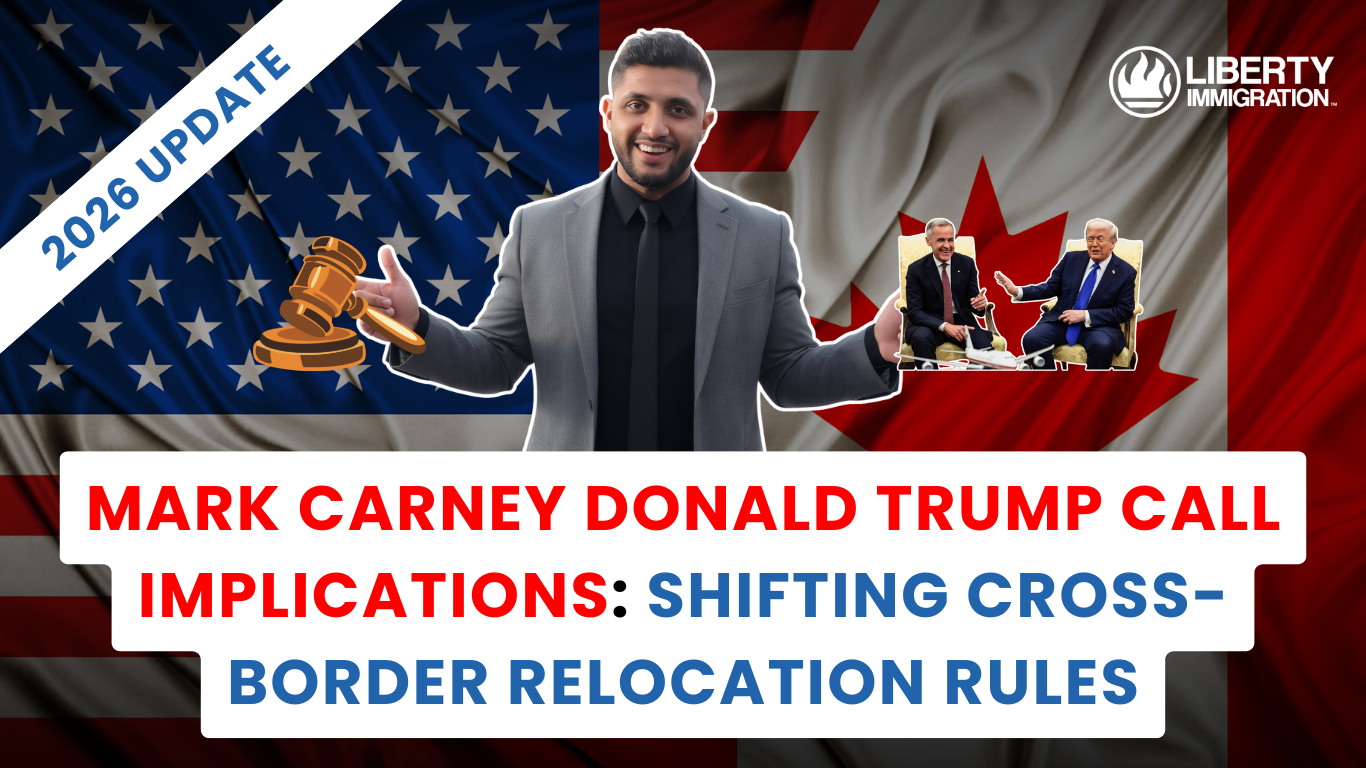
Executive Summary: High-Stakes Continental Mobility Realignment
A series of profound geopolitical discussions between Washington and Ottawa has fundamentally altered the long-term outlook for cross-border corporate transfers, professional trade visas, and North American talent allocation. As executive leadership teams prepare for major trade reviews, understanding the active policy vectors is critical. Review the operational landscape finalized as of June 26, 2026:
- The Leader-Level Dialogue: On Wednesday, June 24, 2026, U.S. President Donald Trump initiated a wide-ranging, "constructive" phone call with Canadian Prime Minister Mark Carney ahead of next month's NATO summit.
- The Imminent CUSMA Deadline: This crucial discussion occurred just days before the **July 1, 2026 joint review deadline**. All three North American nations must formally declare whether they will extend the Canada-United States-Mexico Agreement (CUSMA / USMCA) for another 16 years.
- The "Bad Deal" Stand-off: Highlighting Canada's firm negotiating posture, PM Carney publicly stated on June 25 that while Canada wants to modernize the trade framework, "We’re not going to sign a bad deal, so it has to be a real deal."
- Implications for Professional Visas: If the trilateral parties fail to agree on an unconditioned 16-year extension, CUSMA will automatically roll into an unstable annual review cycle, threatening the predictability of TN visas and cross-border intra-company frameworks.
Mark Carney Donald Trump Call Implications: Shifting Cross-Border Relocation Rules & Everything Else You Need to Know
For multinational corporations moving essential workforces across the 49th parallel, high-skilled professional tech workers, and immigration counsel, tracking leader-level cross-border communication is paramount. Because professional work authorization under North American trade pacts depends entirely on international treaties, any minor shift in executive relations can transform border-level processing standards overnight. This continental integration is facing its most critical test of the decade.
The strategic environment intensified on June 24, 2026, when U.S. President Donald Trump initiated a highly anticipated, long discussion with Canadian Prime Minister Mark Carney. While the conversation covered international security nodes—including NATO defense commitments, Iran, and Arctic infrastructure—it occurred against the backdrop of highly contested trade talks. Speaking at an Ottawa press conference on June 25, PM Carney confirmed that the administration is preparing for extensive modernizations but remains completely ready to walk away from an unfavorable text.
As a leading cross-border immigration consultancy directed by practicing Regulated Canadian Immigration Consultants (RCICs), we monitor these executive branch communications to protect our clients' international personnel. When trade frameworks move toward rolling, short-term review loops, corporate HR departments must shift away from single-track visas and implement robust permanent residency fallbacks. This treaty stability briefing analyzes the mechanics of the latest **mark carney donald trump call**, evaluates the upcoming July 1 CUSMA review threat, and outlines the exact steps required to insulate your corporate talent pipelines.
Anxious About Shifting CUSMA Professional or TN Visa Rules? Schedule an Emergency Vetting with an RCIC Instantly1. The Strategic Backdrop: Decoding the June 2026 Executive Call
The primary takeaway from the **mark carney donald trump call** is the shifting tone and direct leader-to-leader negotiating style that now governs the bilateral relationship. During the Thursday news conference, PM Carney addressed comments from U.S. Ambassador Pete Hoekstra indicating that the two countries were "not anywhere close" to a finalized agreement. Carney downplayed the administrative friction, noting that with President Trump, "What I have seen with the president is that you’re not close to making a deal, and then you make a deal." He added that securing a favorable outcome requires "being prepared, having done the work, knowing what you want."
This leader-level intervention is critical because the United States Trade Representative (USTR) has repeatedly signaled deep dissatisfaction with existing trade flows, targeting Canadian automotive imports, supply-managed dairy systems, and aluminum metrics. While Canada has tried to soothe bilateral tensions by significantly increasing its defense investments—with PM Carney predicting Canada will hit 4% of GDP spent on defense by 2029—the administration continues to use tariff pressures as primary leverage in trade discussions.
2. The July 1 CUSMA Review: The "Rolling Negotiation" Threat to Visas
The true focus for corporate relocation specialists is the legal mechanism embedded inside the treaty's review clause. On July 1, 2026, Canada, the United States, and Mexico must formally exchange written declarations regarding the future of the agreement. While Canadian Trade Minister Dominic LeBlanc has already formally recommended a straightforward, 16-year extension to lock the deal in until 2042, Washington is firmly resisting an unconditioned renewal.
If the trilateral parties fail to achieve an absolute, unanimous extension by the July 1 deadline, the treaty does not immediately terminate. Instead, it shifts directly into a restrictive **"rolling negotiation" framework**, requiring a mandatory joint review every single year for the next decade.
We can model the structural stability index ($S_{\text{visa}}$) of a North American professional work permit under this rolling review model using a basic volatility equation:
$$S_{\text{visa}} = \frac{T_{\text{pact}} \cdot E_{\text{int}}}{1 + \sigma_{\text{tariff}}}$$Where $T_{\text{pact}}$ represents the guaranteed duration of the underlying treaty extension, $E_{\text{int}}$ matches the level of macroeconomic interdependency between the nations, and $\sigma_{\text{tariff}}$ isolates the volatility coefficient generated by ongoing tariff skirmishes and annual political negotiations. When $T_{\text{pact}}$ shrinks from a stable 16-year block down to a shifting 1-year rolling window, the stability index falls significantly, creating a highly unpredictable environment for long-term corporate recruitment.
Review the direct operational impacts a rolling negotiation shift introduces across active cross-border mobility streams:
| Professional Mobility Vector | Stable 16-Year CUSMA Extension Framework (Option A) | The 1-Year Rolling Negotiation Environment (Option B) |
|---|---|---|
| TN / CUSMA Professional Visas | Preserves highly predictable 3-year entries at ports of entry for 60+ designated professional classes. | Increased Risk: Border agents face heightened scrutiny regarding educational alignments and employment intent. |
| L-1 / ICT Inter-Company Transfers | Facilitates the smooth, reciprocal transfer of executives and managers to regional branch offices. | Auditing Influx: Increased documentation requests regarding corporate entity relationships and specialized knowledge. |
| Corporate Investment and Talent Sourcing | Encourages long-term capital placement, safely backed by stable, long-term labor rules. | Chilled Investment: Companies delay multi-year talent placements due to persistent treaty uncertainty. |
3. The Professional Fallback: Transitioning Off Shifting Trade Visas
The lesson of the **mark carney donald trump call** and the approaching July 1 deadline is that relying solely on temporary trade-dependent visas leaves corporate talent pools vulnerable to sudden political changes. To insulate your business or personal family plan from long-term treaty changes, you should work with an RCIC to transition temporary work permits onto stable permanent resident pathways.
Pillar 1: Proactive Global Talent Stream (GTS) Ingestion
Multinational companies can protect their highly skilled technical teams from shifting non-immigrant caps by utilizing Canada's Global Talent Stream (GTS). This dedicated track bypasses standard labor bottlenecks, processing eligible engineering and software applications within a predictable 10-day service standard to ensure immediate, secure status.
Pillar 2: Accelerating PR-Supporting LMIAs
Recent performance data from ESDC reveals that processing times for permanent resident supporting LMIAs have improved significantly, dropping by 26 days down to an efficient **114 days**. Securing a permanent, positive labor market test allows professionals to gain essential Express Entry ranking points, insulating their files from temporary visa restrictions.
Pillar 3: Utilizing the Bill C-3 Ancestry Safe Haven
For outland applicants tracking these treaty discussions with concern, checking your family lineage can uncover an alternative path. Canada’s updated Bill C-3 legislation has permanently removed the old first-generation limit on citizenship by descent. If you possess a parent or grandparent born on Canadian soil, you hold an un-shakable birthright to a second passport that cannot be modified by rolling trade reviews. Ensure your application features certified long-form copies ordered directly from original provincial archives to pass triage smoothly.
Shield Your Global Workforce and Corporate Status from Treaty Instability
The high-stakes dialogue confirmed in the recent **mark carney donald trump call** proves that North American mobility rules can change rapidly as the July 1 CUSMA review deadline approaches. Relying on a single temporary trade visa leaves your operations exposed to unexpected border scrutiny and processing delays. Let our elite team of professional RCICs perform a comprehensive check of your employee pool, structure bulletproof permanent residency transitions, and secure your cross-border success safely.
Book Your Emergency Treaty Alignment Consultation NowTop 5 FAQs: Mastering Cross-Border Relocation and Treaty Shifts
1. What are the immigration implications of the recent mark carney donald trump call?
While the **mark carney donald trump call** focused primarily on international security, it established the framework for leader-level negotiations ahead of the critical July 1 CUSMA deadline, directly impacting the long-term stability of North American work permits.
2. What happens to TN and CUSMA professional visas if the treaty is not extended for 16 years?
If the parties fail to agree on a 16-year extension, CUSMA enters a "rolling negotiation" phase subject to mandatory annual reviews. This annual cycle increases border-level scrutiny and creates long-term uncertainty for corporate talent planning.
3. Can a company use an Intra-Company Transfer (ICT) to move workers if CUSMA faces annual reviews?
Yes. The Intra-Company Transfer (ICT) pathway remains fully operational, but under an annual review environment, companies must expect tighter enforcement and extensive documentation requests regarding corporate relationships and specialized knowledge criteria.
4. How can the Global Talent Stream help businesses manage cross-border treaty risk?
Canada’s Global Talent Stream (GTS) provides an excellent alternative, processing highly skilled tech and engineering applications within a reliable 10-day service standard, allowing firms to secure talent independently of trade pact fluctuations.
5. Can an RCIC assist me in updating an active work permit file during these trade talks?
Yes, absolutely. A licensed RCIC can audit your employment credentials, ensure your target NOC codes map correctly to active immigration programs, and proactively upload certified updates via the webform to keep your application moving smoothly.
More Helpful Resources on Adjudication Precedents and Inventory Controls
- The Timeline Drop: Reviewing the Latest In-Canada Work Permit Processing Times Update
- The Ancestry Shift: Navigating Heightened Scrutiny for Family Class Lineage Proofs Under Form CIT 0014
- The Explanation Brief: How to Correctly Format Your Case Layout Letter of Explanation PDF
- RCIC Strategy Portal: Schedule an Emergency Status Continuity Vetting with Our Licensed Expert Team
© 2026 Liberty Immigration. All rights reserved. | Book an RCIC Consultation
Related Blogs:

Written By
Vineet Tiwari
Vineet is a caring and creative leader who has lived in India, Oman, UAE, and Canada, giving him a rich multicultural perspective. His commitment to physical fitness keeps him energetic and focused. Vineet's dedication to his clients is evident as he often takes calls on weekends, ensuring they always feel supported and valued. His diverse background and unwavering availability help build strong, trusting relationships with our clients.
