
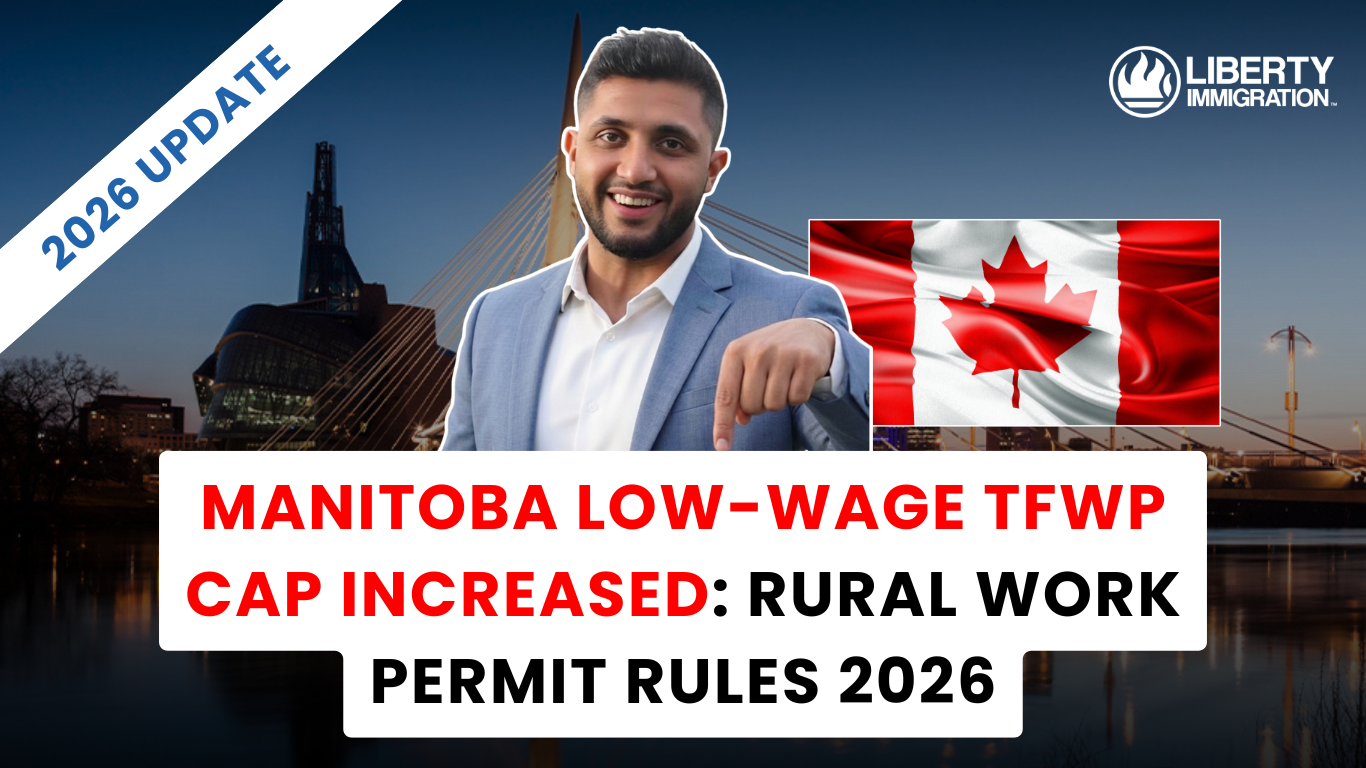
Manitoba Low-Wage TFWP Cap Increased: Rural Work Permit Rules 2026
Executive Summary: The 2026 Manitoba LMIA Expansion
Hello! I am RCIC Vineet. If you are an employer or a foreign worker in rural Manitoba, relief has arrived. Recognizing severe labor shortages in northern and rural regions, the provincial government has officially opted into federal measures to increase the Manitoba low-wage TFWP cap.
- The Core Change: Effective April 14, 2026, eligible rural employers in Manitoba can hire up to 15% of their workforce through the low-wage stream of the Temporary Foreign Worker Program (up from the strict 10% standard cap).
- Retention Clause: Employers can also retain their current proportion of low-wage TFWs at a given worksite, even if it currently exceeds the usual 10% limit.
- The Regional Exclusion: This policy applies to all sectors but strictly excludes the Winnipeg Census Metropolitan Area (CMA). It is designed purely for rural economic development.
- The Timeline: These emergency measures are temporary and will remain legally in effect until March 31, 2027.
Manitoba Low-Wage TFWP Cap Increased: Rural Work Permit Rules 2026
For businesses operating outside of Canada's major urban centers, the strict rules of the Temporary Foreign Worker Program (TFWP) have been a historic roadblock to growth. The federal government’s standard policy restricts employers from hiring more than 10% of their workforce through the TFWP low-wage stream—a cap that has starved rural businesses of essential labor.
However, the landscape changed on April 14, 2026. Following in the footsteps of Nova Scotia and Quebec, Manitoba has officially become the third province to opt into the new temporary federal measures introduced by Employment and Social Development Canada (ESDC) in March 2026. By increasing the Manitoba low-wage TFWP cap, the province aims to aggressively combat ongoing labor shortages in its rural and northern regions.
As a Regulated Canadian Immigration Consultant (RCIC), I am already helping employers across rural Manitoba submit updated Labour Market Impact Assessments (LMIAs) to capitalize on this increased quota. Here is everything employers and foreign workers need to know about navigating these new measures before they expire on March 31, 2027.
Need an LMIA in Rural Manitoba? Book a Corporate Assessment Today1. What Exactly Changed on April 14, 2026?
The new measures target the "Low-Wage" stream of the TFWP. By definition, a low-wage position is any job where the offered wage falls below the provincial median hourly wage for Manitoba.
Starting April 14, 2026, eligible employers operating in rural Manitoba benefit from two massive concessions:
| The New 2026 Measure | How It Impacts Employers |
|---|---|
| 1. The 15% Cap Increase | Employers can now hire up to 15% of their total workforce through low-wage TFWP positions, a direct 50% increase from the standard 10% federal cap. |
| 2. The Retention Clause | Employers are permitted to retain their current proportion of low-wage temporary foreign workers at a specific worksite, even if that proportion already exceeds the standard 10% limit. |
It is critical to note that these new measures only apply to new LMIA applications submitted on or after April 14, 2026. Furthermore, low-wage positions filed under the Permanent Resident (PR) dual-intent stream are specifically excluded from these cap exemptions.
2. What Does "Rural" Mean Under the New Rules?
Do not assume that just because your business is in a smaller town, it qualifies. ESDC and the Manitoba government are using strict geographic definitions provided by Statistics Canada.
Under this policy, "rural" is defined as any location strictly outside the Winnipeg Census Metropolitan Area (CMA). If your worksite falls within the geographic boundaries of the Winnipeg CMA, you are bound by the standard 10% cap. If your worksite is outside this boundary (e.g., Brandon, Thompson, Steinbach, or Portage la Prairie), you are eligible for the 15% Manitoba low-wage TFWP cap.
3. The Impact on Employers and Foreign Workers
For Rural Manitoba Employers:
This is a much-needed lifeline. Many agricultural, manufacturing, and hospitality businesses in northern and rural Manitoba were approaching or had already hit their 10% cap, forcing them to run short-staffed or reduce operational hours. The increased Manitoba low-wage TFWP cap provides the immediate legal room needed to retain existing trained workers and launch new recruitment drives.
For Temporary Foreign Workers:
If you are a low-wage worker currently employed in rural Manitoba, this policy dramatically increases your job security. Your employer will no longer face immediate federal pressure to reduce foreign worker headcounts at your worksite. Additionally, if you are a foreign national looking for a work permit, this higher cap instantly opens up hundreds of previously locked positions across rural Manitoba.
4. Core LMIA Requirements Remain Unchanged
While the cap has been lifted, the rigorous bureaucracy of the TFWP has not. Employers hoping to utilize the 15% Manitoba low-wage TFWP cap must still prove they cannot find local talent.
Employers must continue to:
- Obtain an LMIA: Apply to ESDC and pay the $1,000 CAD processing fee for each requested position.
- Prove Recruitment Efforts: Conduct mandatory, extensive advertising (including on the national Job Bank) for at least 4 weeks to prove they tried to recruit Canadian citizens and permanent residents first.
- Meet Financial Obligations: Pay the prevailing wage for the occupation, provide suitable working conditions, and assist with affordable housing and round-trip transportation as required by the low-wage stream rules.
Don't Let Your LMIA Get Refused
Applying under the new 15% cap requires exact corporate documentation and flawless recruitment proofs. Let our licensed RCIC team manage your LMIA applications to ensure you secure your workers before the March 2027 deadline.
Book an Employer LMIA ConsultationTop 20 FAQs: Manitoba Low-Wage TFWP Cap Increase (2026)
To help businesses and workers navigate this temporary policy, here are the 20 most frequently asked questions regarding the new Manitoba low-wage TFWP cap rules.
1. What is the new Manitoba low-wage TFWP cap for 2026?
Effective April 14, 2026, the cap on low-wage temporary foreign workers for eligible rural employers in Manitoba has been increased from the standard 10% to 15% of their total workforce.
2. When did the new Manitoba TFWP rules take effect?
The new measures officially took effect on April 14, 2026, and apply only to LMIA applications submitted on or after this date.
3. When does this temporary public policy end?
The increased Manitoba low-wage TFWP cap is a temporary measure designed to combat labor shortages and will remain in place until March 31, 2027.
4. Does the 15% cap apply to businesses in Winnipeg?
No. The policy explicitly excludes businesses located within the Winnipeg Census Metropolitan Area (CMA). Employers in Winnipeg remain subject to the standard 10% cap.
5. How is "rural" defined for this exemption?
In the context of these measures, 'rural' means any geographic location in Manitoba that falls completely outside the boundaries of the Winnipeg CMA, as defined by Statistics Canada.
6. What is the 'Retention Clause' under the new rules?
The retention clause allows rural employers to keep their current proportion of low-wage positions filled by TFWs at a given worksite, even if that number is currently over the usual 10% cap.
7. What is a "low-wage" position in Manitoba?
A low-wage position under the TFWP is defined as any job where the offered hourly wage falls below the median hourly wage for the province of Manitoba, as determined by federal labor data.
8. Do these measures apply to the high-wage TFWP stream?
No. High-wage positions (those paying at or above the provincial median wage) are not subject to the 10% or 15% workforce cap. This policy only affects the low-wage stream.
9. Which other provinces are using this rural cap exemption?
Manitoba is the third province to opt into these temporary federal measures, following similar agreements signed by Nova Scotia and Quebec earlier in 2026.
10. Does this remove the need for an LMIA?
No. The increased Manitoba low-wage TFWP cap simply raises the maximum quota of foreign workers you can hire. You must still apply for, pay for, and obtain an approved Labour Market Impact Assessment (LMIA).
11. Are dual-intent PR stream LMIAs included?
No. Low-wage positions submitted under the permanent resident 'dual-intent' stream are specifically excluded from these new 15% cap measures.
12. Do employers still have to advertise the job to Canadians?
Yes. All standard TFWP recruitment requirements remain strictly in effect. Employers must advertise the job on the national Job Bank and two other acceptable platforms for at least 4 weeks prior to applying for the LMIA.
13. Does the 15% cap apply per worksite or company-wide?
The TFWP cap is calculated per specific worksite. If a company has multiple locations, the 15% cap is calculated individually for each eligible rural location.
14. What if I submitted an LMIA before April 14, 2026?
The new measures are not retroactive. The 15% cap and retention clauses only apply to brand new LMIA applications officially submitted to ESDC on or after April 14, 2026.
15. Why did Manitoba opt into this policy?
The Manitoba government opted into the ESDC policy to address severe, ongoing labor market shortages that are disproportionately impacting rural and northern regions of the province.
16. Who announced these temporary measures?
The temporary measures were introduced by Employment and Social Development Canada (ESDC) in March 2026, allowing individual provinces to 'opt-in' based on their regional labor needs.
17. Does this policy affect the Provincial Nominee Program (MPNP)?
No, this policy specifically governs the federal Temporary Foreign Worker Program (TFWP). However, gaining a work permit through this stream allows workers to build the necessary experience to apply for the MPNP later.
18. Are specific sectors targeted by this cap increase?
No. Unlike previous targeted policies, this measure applies across all industry sectors in rural Manitoba, from agriculture and manufacturing to retail and hospitality.
19. Do employers still need to provide housing for low-wage workers?
Yes. The core rules of the low-wage TFWP stream still apply, which mandates that employers must ensure suitable, affordable housing is available for the foreign worker, among other protections.
20. Should I hire an RCIC to submit my LMIA under the new cap?
Yes. Ensuring your worksite qualifies as 'rural' under Statistics Canada definitions and perfectly calculating your workforce cap percentage is highly technical. An RCIC prevents costly LMIA refusals.
Trending 2026 Provincial Nominee Updates
- New Brunswick issues more than 140 invitations across Express Entry and AIP draws
- Newfoundland and Labrador holds third provincial immigration selection round of 2026
- Saskatchewan has already used one quarter of its 2026 nomination allocation
- British Columbia holds April draw, issues invitations to entrepreneurs
© 2026 Liberty Immigration. All rights reserved. | Book a Consultation
Related Blogs:



Written By
Vineet Tiwari
Vineet is a caring and creative leader who has lived in India, Oman, UAE, and Canada, giving him a rich multicultural perspective. His commitment to physical fitness keeps him energetic and focused. Vineet's dedication to his clients is evident as he often takes calls on weekends, ensuring they always feel supported and valued. His diverse background and unwavering availability help build strong, trusting relationships with our clients.
