
Express Entry Profile Creation 2026 Guide: Step-by-Step Walkthrough, Required Documents & Everything Else You Need to Know
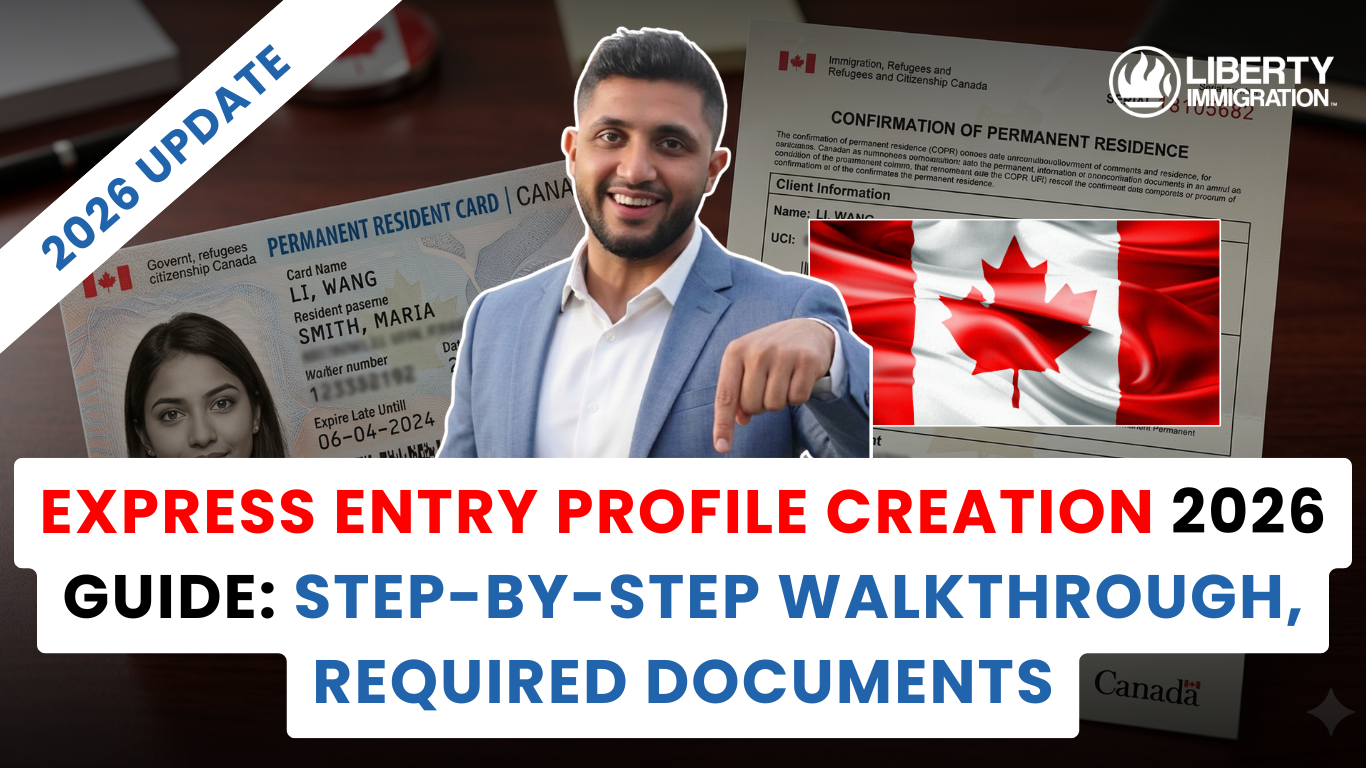
Executive Summary: Navigating Profile Creation in 2026
Initiating your express entry profile creation remains the definitive starting point for economic immigration to Canada. In 2026, the parameters governing the application pool are highly dynamic due to category-based draws and targeted occupations. RCIC Vineet highlights the foundational protocols needed to secure an Invitation to Apply (ITA).
- The Baseline Rule: An online profile can only be created once your official language metrics and education credentials are in hand. Profiles are valid for 12 months.
- Category-Based Shifts: IRCC has expanded targeted draws for 2026, adding dedicated streams for physicians, senior managers, and researchers alongside trades, STEM, and French speakers.
- The Core Trap: A single data mismatch or a misaligned National Occupational Classification (NOC) code will lead to an immediate administrative rejection post-ITA.
- Latest Processing Context: In the May 2026 updates, processing times for finalized Express Entry lines are tracking at an average of 7 months.
Express Entry Profile Creation 2026 Guide: Step-by-Step Walkthrough, Required Documents & Everything Else You Need to Know
Turning your Canadian permanent residency goals into a reality requires entering the federal pool with an immaculate record. The process of express entry profile creation is not an application itself—it is your formal declaration of interest to the Government of Canada under the Comprehensive Ranking System (CRS).
In 2026, simply meeting the minimum baseline points is no longer the target. IRCC's system heavily favors candidate profiles optimized for targeted industry gaps. If your documentation is flawed, or if your employment details conflict with the official ministerial requirements, your application face rejection or lengthy review cycles after you are drawn.
As a licensed RCIC, I have built this master blueprint to ensure your profile is executed cleanly. From sourcing credential verifications to navigating the complex NOC grid, here is your step-by-step roadmap to successful execution.
Optimize Your Express Entry Profile: Schedule an RCIC Audit Today1. What Documents are Mandatory Before Profile Creation?
You cannot save a blank profile or input placeholder numbers. The IRCC online portal requires the inputs from final, valid, and authentic testing documents. Attempting your express entry profile creation without these key pieces in your hand is impossible.
Before launching the portal questionnaire, you must compile the following core pieces:
- A Valid Passport: Must be the primary travel document you intend to use throughout your immigration journey.
- Official Language Test Results: Your scores from an IRCC-approved testing body (IELTS or CELPIP for English, PTE Core, or TEF/TCF for French). These results must be less than two years old on the day you submit your profile and eventual PR package.
- Educational Credential Assessment (ECA): If your degree or diploma was obtained outside of Canada, it must be verified by an approved assessment agency (such as WES, IQAS, or ICAS). ECAs remain valid for a maximum of 5 years.
- Provincial Nomination Certificate: If you are entering the pool via an enhanced provincial nomination stream, you must have your nomination details ready to unlock the instant +600 CRS point boost.
2. Step-by-Step: Navigating the Express Entry Profile Creation Portal
Once your prerequisite documents are in order, the digital construction phase takes roughly 1 to 3 hours. Accuracy across every text field is mandatory to ensure your profile stands up to the R10 completeness check later on.
| Phase | Core Action Item | Critical Regulatory Insight |
|---|---|---|
| Step 1: The Account Setup | Register for a secure GCKey account on the official Canada.ca platform. | Keep your security questions and login recovery details completely secure. This account houses your application for the entire timeline. |
| Step 2: The "Come to Canada" Check | Complete the initial eligibility questionnaire to generate a Personal Reference Code. | The system assesses if you meet the baseline entry gates for the FSWP, CEC, or FSTP. You need a minimum of 67 points on the selection factor grid for the FSWP. |
| Step 3: Personal & Family Data Entry | Transfer your reference code to link your data. Input passport details, accompanying family info, and personal background. | Ensure names match your passport biographic page exactly down to the middle initials to prevent identity flags. |
| Step 4: Education & Language Input | Enter the exact reference numbers from your language test report sheet and your ECA validation document. | IRCC uses automated backend verification systems to pull scores from databases like British Council or WES. Typos in report numbers cause system errors. |
| Step 5: Work History & NOC Codes | Declare your work history for the last 10 years, assigning an accurate National Occupational Classification code to each role. | You must focus on the core duties performed, not just your formal job title. Gaps in dates are scrutinized closely. |
3. Avoiding the Fatal NOC Code and Work Experience Traps
The single leading cause of visa officer refusals after an invitation is issued occurs during your initial **express entry profile creation** work history declarations. IRCC does not evaluate your eligibility based on your internal company job title—they look exclusively at your real, daily responsibilities.
When selecting your code under the National Occupational Classification system, you must review the "Lead Statement" and ensure that your daily activities cover a substantial number of the "Main Duties" listed in the official NOC description. If you claim to be a Software Engineer (NOC TEER 1), but your employment reference letter only lists simple data entry tasks, your application will face rejection for misrepresentation or a lack of qualified experience.
For 2026 category-based selection rounds (such as Healthcare, STEM, Trades, or the new streams for physicians and senior managers), candidates must demonstrate a minimum of 12 months of experience in that specific occupation within the last 3 years. This must total approximately 1,560 hours, though it does not need to be continuous.
4. What Happens After Your Profile is Submitted?
Once you click the final submit block, your profile joins the active pool of global candidates. Your profile is automatically given a CRS score based on core factors like your age, education level, language results, and adaptability metrics. Your status in the pool stays live for exactly **12 months**.
While sitting in the pool, you are legally obligated to update your profile the moment any of your circumstances change. If you complete an additional year of work experience, receive updated language test scores, or change your marital status, your profile must reflect this data immediately. If you are drawn with an outdated score that cannot be verified by your final documents, your entire permanent residence application will be refused.
| Immigration Stream | 2026 Actual Processing Speed | IRCC Internal Service Standard |
|---|---|---|
| Canadian Experience Class (CEC) | 7 Months | 6 Months |
| Federal Skilled Worker Program (FSWP) | 7 Months | 6 Months |
| Enhanced Provincial Nominee Program (PNP) | 7 Months | 6 Months |
Unless you are currently authorized to work in Canada AND hold a valid job offer, FSWP candidates must maintain liquid settlement funds matching the updated LICO thresholds. These funds must be completely unencumbered and held in personal bank accounts continuously from the day of your initial profile creation until your PR visa is issued.
Do Not Risk a 5-Year Misrepresentation Ban
An innocent typo or a misaligned NOC choice during your express entry profile creation can trigger a devastating refusal or a long-term ban from Canada. Let our team of licensed RCIC experts audit your documentation, verify your duties, and submit a compliant profile to maximize your chances at an ITA.
Book Your Express Entry Assessment NowTop 5 FAQs: Express Entry Profile Setup in 2026
1. Does it cost any money to create an Express Entry profile?
No. IRCC does not charge any government fees to initiate your initial profile creation or to enter the candidate pool. You will only pay formal processing fees ($1,590 CAD per adult) once you receive an official Invitation to Apply (ITA) and submit your complete PR package.
2. How long does my profile stay active in the candidate pool?
Your profile remains live in the Express Entry pool for exactly 12 months from the day of submission. If you do not receive an ITA within that one-year window, your profile automatically expires, and you must build a new profile to continue tracking draws.
3. Can I reuse an old language test score for my profile?
Your language scores (IELTS, CELPIP, PTE Core, or TEF/TCF) must be less than two years old on the day you submit your profile and on the day you file your final PR application. If your test results expire while you are in the pool, your profile will instantly become invalid.
4. What is the difference between a job title and a NOC code assignment?
A job title is simply your company's internal naming convention, whereas a NOC code is a standardized classification based on real duties. IRCC assesses your experience based on the duties listed in your employment letters, meaning your selected NOC must match your daily responsibilities rather than your literal job title.
5. Can I apply for permanent residency right after creating my profile?
No. Entering the pool does not mean you have applied for PR. You must wait for IRCC to conduct an official draw. If your CRS score is equal to or higher than the draw cutoff, you will receive an Invitation to Apply (ITA). You then have 60 days to submit your final application.
More in Express Entry & Processing Time Updates
© 2026 Liberty Immigration. All rights reserved. | Book an RCIC Consultation
Related Blogs:



Written By
Vineet Tiwari
Vineet is a caring and creative leader who has lived in India, Oman, UAE, and Canada, giving him a rich multicultural perspective. His commitment to physical fitness keeps him energetic and focused. Vineet's dedication to his clients is evident as he often takes calls on weekends, ensuring they always feel supported and valued. His diverse background and unwavering availability help build strong, trusting relationships with our clients.
