
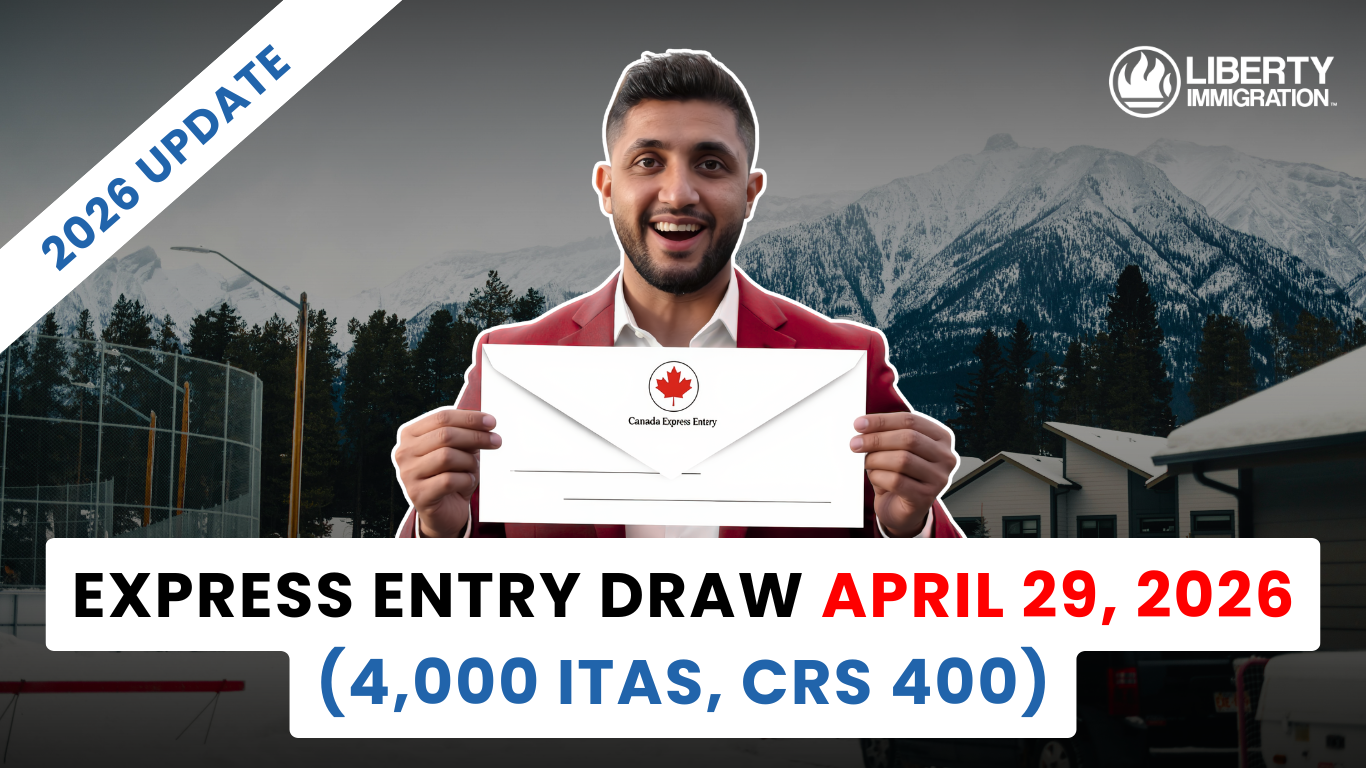
Express Entry Draw April 29, 2026 (4,000 ITAs, CRS 400)
Executive Summary: The Triple-Draw Week Phenomenon
Immigration, Refugees and Citizenship Canada (IRCC) just capped off an explosive week for permanent residence hopefuls. The Express Entry Draw April 29, 2026 marked the third consecutive draw in as many days. RCIC Vineet notes that IRCC is aggressively prioritizing domestic applicants and French speakers over the general international pool.
- The April 29 Draw: 4,000 Invitations to Apply (ITAs) were issued strictly to candidates with French-language proficiency. The Comprehensive Ranking System (CRS) cut-off plummeted to a remarkably low 400 points.
- A Week of ITAs: The Express Entry Draw April 29, 2026 followed a Provincial Nominee Program (PNP) draw on April 27 (473 ITAs) and a Canadian Experience Class (CEC) draw on April 28 (2,000 ITAs).
- The 2026 Trend: In 2026, IRCC has issued an incredible 71,627 ITAs. The Canadian Experience Class remains the dominant pathway (34,250 ITAs), with French-language proficiency sitting firmly in second place (26,000 ITAs).
- The "Cheat Code": If your CRS score is languishing in the 400s, learning French or securing a PNP is your only mathematically viable pathway to bypass the 500+ general draw cut-offs.
BREAKING: Express Entry Draw April 29, 2026 Issues 4,000 ITAs (CRS Drops to 400)
If you have been waiting in the Express Entry pool watching cutoff scores sit stubbornly in the 520s, April 2026 has been a month of targeted relief. The Canadian government is shifting its strategy, ignoring the "General" pool entirely in favor of highly specialized, domestic-focused draws.
IRCC executed the highly anticipated Express Entry Draw April 29, 2026, issuing a massive 4,000 Invitations to Apply (ITAs) exclusively to candidates demonstrating French-language proficiency. Most incredibly, the CRS cut-off score dropped to a mere 400 points—a score easily achievable for younger applicants even without Canadian work experience or a Master's degree.
This draw represents the 26th overall selection of the year and the fifth draw specifically dedicated to the French-language category. RCIC Vineet breaks down the statistics, the tie-breaking rules, and exactly what the Express Entry Draw April 29, 2026 means for your PR strategy moving forward.
Is Your CRS Score Stuck Below 450? Book a Strategy Audit Today1. Breakdown of the Express Entry Draw April 29, 2026
The Express Entry Draw April 29, 2026 was highly targeted. To be considered in this specific selection round, candidates had to meet strict parameters:
- Category: French-Language Proficiency (Category-Based Selection).
- ITAs Issued: 4,000.
- Minimum CRS Score: 400.
- Tie-Breaking Rule: If multiple candidates had exactly 400 points, IRCC prioritized those who created their Express Entry profile before April 7, 2026, at 8:13 p.m. UTC.
This draw concluded a rapid-fire "triple draw" week by IRCC. On April 27, they invited 473 PNP candidates (CRS 795), followed by an April 28 draw inviting 2,000 CEC candidates (CRS 514). This pattern proves that IRCC is focusing heavily on candidates who are already inside the country contributing to the economy, or those who can support Francophone minority communities outside of Quebec.
2. The Complete 2026 Express Entry Draw History
To truly understand how competitive your profile is, you must look at the larger dataset. So far in 2026, IRCC has conducted 26 draws. General "No Program Specified" draws are completely absent from this list, replaced entirely by specific categories.
| Date | Draw Type | CRS Cut-off Score | ITAs Issued |
|---|---|---|---|
| April 29 | French-Language proficiency | 400 | 4,000 |
| April 28 | Canadian Experience Class | 514 | 2,000 |
| April 27 | Provincial Nominee Program | 795 | 473 |
| April 15 | French-Language proficiency | 419 | 4,000 |
| April 14 | Canadian Experience Class | 515 | 2,000 |
| April 13 | Provincial Nominee Program | 786 | 324 |
| April 2 | Trades | 477 | 3,000 |
| March 31 | Canadian Experience Class | 509 | 2,250 |
| March 30 | Provincial Nominee Program | 802 | 356 |
| March 18 | French-Language proficiency | 393 | 4,000 |
| March 17 | Canadian Experience Class | 507 | 4,000 |
| March 16 | Provincial Nominee Program | 742 | 362 |
| March 5 | Senior Managers with Canadian Work Experience | 429 | 250 |
| March 4 | French-Language proficiency | 397 | 5,500 |
| March 3 | Canadian Experience Class | 508 | 4,000 |
| March 2 | Provincial Nominee Program | 710 | 264 |
| February 20 | Healthcare and social services | 467 | 4,000 |
| February 19 | Physicians with Canadian work experience | 169 | 391 |
| February 17 | Canadian Experience Class | 508 | 6,000 |
| February 16 | Provincial Nominee Program | 789 | 279 |
| February 6 | French-Language proficiency | 400 | 8,500 |
| February 3 | Provincial Nominee Program | 749 | 423 |
| January 21 | Canadian Experience Class | 509 | 6,000 |
| January 20 | Provincial Nominee Program | 746 | 681 |
| January 7 | Canadian Experience Class | 511 | 8,000 |
| January 5 | Provincial Nominee Program | 711 | 574 |
3. The 2026 Strategy: By the Numbers
By analyzing the raw data of the Express Entry Draw April 29, 2026 and the preceding months, a clear picture of IRCC's mandate emerges. Thus far in 2026, IRCC has issued a total of 71,627 ITAs.
If you do not fit into one of the top two categories, your chances of receiving an ITA are statistically minuscule.
| Draw Type | Total ITAs Issued (2026) | Total Number of Draws |
|---|---|---|
| Canadian Experience Class (CEC) | 34,250 | 8 |
| French-Language proficiency | 26,000 | 5 |
| Healthcare and social services | 4,000 | 1 |
| Provincial Nominee Program (PNP) | 3,736 | 9 |
| Trades | 3,000 | 1 |
| Physicians with Canadian work experience | 391 | 1 |
| Senior Managers with Canadian Work Experience | 250 | 1 |
Noticeably absent from the 2026 data so far are draws specifically targeting the Federal Skilled Worker (FSW) program. IRCC is laser-focused on candidates with established Canadian ties (CEC) or linguistic advantages (French), leaving offshore candidates without French skills stranded in the pool.
4. How to React to the Express Entry Draw April 29, 2026
The numbers do not lie. If your CRS score is hovering between 400 and 480, hoping for a general draw is no longer a viable strategy. You have two primary paths to secure an ITA in 2026:
- Learn French: As proven by the Express Entry Draw April 29, 2026, the French-language category bypasses high CRS requirements entirely. Securing NCLC 7 in French not only makes you eligible for these massive draws but mathematically boosts your core CRS score by up to 62 points.
- Secure a PNP: With 9 PNP draws already conducted this year, securing a provincial nomination remains the ultimate safety net. A PNP injects 600 CRS points into your profile, effectively guaranteeing an ITA in the very next draw.
Don't Expire in the Pool
If your CRS score is below 500, you need a new strategy. Let our licensed RCIC team analyze your profile, target specific PNP streams, or guide you toward a French-language pivot.
Book a Comprehensive Profile AuditTop 20 FAQs: Navigating the Express Entry Draw April 29, 2026
With cutoffs dropping drastically for specific categories, candidates are full of questions. Here are the 20 most frequently asked questions regarding the Express Entry Draw April 29, 2026 and overall pool strategy.
1. What was the CRS cutoff for the Express Entry Draw April 29, 2026?
In the April 29, 2026 draw, the CRS cutoff dropped to 400 points, specifically for candidates eligible under the French-language proficiency category.
2. How many ITAs were issued on April 29, 2026?
IRCC issued exactly 4,000 Invitations to Apply (ITAs) in the April 29 French-language draw.
3. What does the tie-breaking rule mean?
When multiple candidates have the exact cutoff score (e.g., 400), IRCC uses a timestamp tie-breaker. For the April 29 draw, only those with 400 points who created their profile before April 7, 2026, at 8:13 p.m. UTC received an ITA.
4. How do I qualify for a French-language proficiency draw?
You must score a minimum of NCLC 7 in all four abilities (reading, writing, listening, speaking) on an approved French language test like the TEF Canada or TCF Canada.
5. Are there any 'General' (No Program Specified) draws in 2026?
So far in 2026, IRCC has completely avoided General draws, shifting its focus entirely to Category-Based selections (like French and Healthcare) and program-specific draws (like CEC and PNP).
6. What is the Canadian Experience Class (CEC)?
The CEC is a federal immigration program for candidates who have acquired at least one year of skilled, professional, or technical work experience inside Canada within the last three years.
7. Why are CEC scores higher than French scores?
The CEC pool is massive, filled with hundreds of thousands of international graduates and workers already in Canada, making it highly competitive (driving scores over 500), whereas the French-speaking pool is much smaller.
8. How many total ITAs have been issued in 2026?
As of April 29, IRCC has issued an incredible 71,627 Invitations to Apply across 26 different Express Entry draws in 2026.
9. Do I need a job offer to get an ITA?
No. The majority of candidates invited in the CEC and French-language draws do not hold formal LMIA-backed job offers; they are invited based purely on their human capital points.
10. What was the CRS cutoff for the April 28 CEC draw?
The cutoff for the April 28, 2026, Canadian Experience Class draw was 514 points, with 2,000 ITAs issued.
11. Why are PNP cutoffs always so high (700+)?
When a candidate receives a Provincial Nomination, they automatically receive 600 bonus CRS points. Therefore, a candidate with a base score of 150 instantly jumps to 750, naturally inflating the cutoff for PNP-only draws.
12. Can Federal Skilled Worker (FSW) candidates get drawn in 2026?
Yes, but generally only if they qualify for a Category-Based draw (like French or Healthcare) or secure a PNP. There have been no FSW-specific or General draws so far this year.
13. Does working as a doctor give me a lower CRS requirement?
Yes. IRCC conducted a specific draw for Physicians with Canadian work experience in February 2026, where the CRS cutoff was incredibly low, at just 169 points.
14. What happens after I receive an ITA?
You have exactly 60 calendar days to submit a complete permanent residence application online, including medical exams, police certificates, proof of funds, and employment reference letters.
15. Can I reject an ITA if my documents aren't ready?
Yes. If you decline the ITA within the 60-day window, your profile is returned to the active Express Entry pool without penalty, allowing you to be selected in a future draw.
16. What is the Trades category draw?
It is a Category-Based selection targeting individuals with recent experience in specific skilled trades (like plumbers, electricians, carpenters). A draw in April 2026 invited 3,000 tradespeople with a CRS of 477.
17. Do I need to live in Quebec if I apply under the French category?
No. In fact, Express Entry is for candidates intending to live anywhere in Canada *except* Quebec. The French category is specifically designed to boost Francophone immigration outside of Quebec.
18. Are there draws for senior managers?
Yes, occasionally. In March 2026, IRCC conducted a highly targeted draw for Senior Managers with Canadian Work Experience, inviting 250 candidates with a cutoff of 429.
19. How do I improve my CRS score if it's stuck at 450?
The fastest methods are maxing out your English test scores (CELPIP/IELTS), gaining an additional year of Canadian work experience, securing a provincial nomination, or taking the TEF/TCF to qualify for the French draws.
20. Does updating my profile change my tie-breaking timestamp?
Updating information within your existing profile does not change your timestamp. However, if your profile expires after 12 months and you create a brand new one, your timestamp resets to the new creation date.
Trending 2026 Express Entry Updates
© 2026 Liberty Immigration. All rights reserved. | Book a Consultation
Related Blogs:




Written By
Vineet Tiwari
Vineet is a caring and creative leader who has lived in India, Oman, UAE, and Canada, giving him a rich multicultural perspective. His commitment to physical fitness keeps him energetic and focused. Vineet's dedication to his clients is evident as he often takes calls on weekends, ensuring they always feel supported and valued. His diverse background and unwavering availability help build strong, trusting relationships with our clients.
