
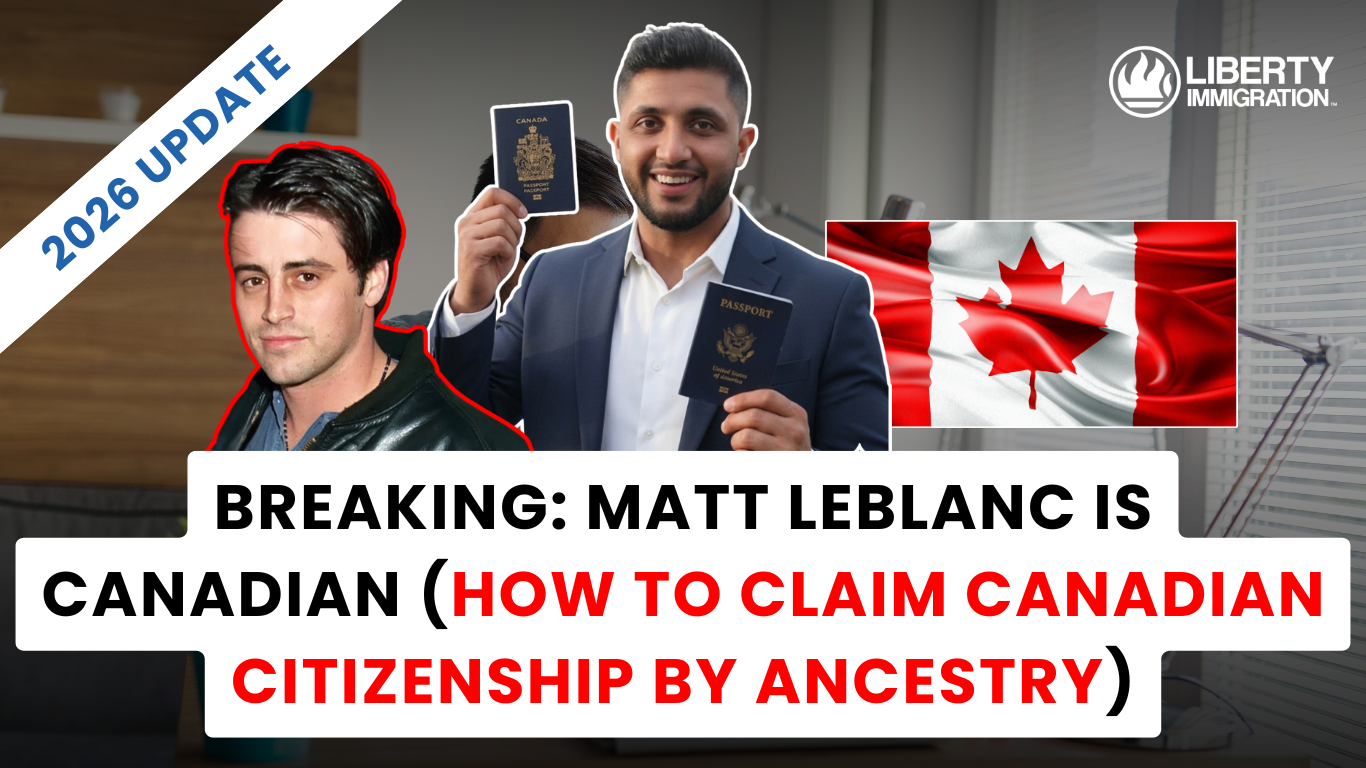
BREAKING: Matt LeBlanc Is Canadian (How to Claim Canadian Citizenship by Ancestry)
Executive Summary: Are You Secretly Canadian?
Following a massive change to Canada's Citizenship Act, millions of Americans have woken up to discover they are legally Canadian—including Friends star Matt LeBlanc. RCIC Vineet explains how the new 2026 laws surrounding Canadian citizenship by ancestry have eliminated generational limits, creating the ultimate geopolitical backup plan for US citizens with northern roots.
- The "Friends" Connection: Thanks to his Acadian heritage in New Brunswick, Matt LeBlanc (Joey) has officially joined Matthew Perry (Chandler) as a U.S.-Canadian dual citizen.
- The December 15 Cutoff: Bill C-3 removed the "first-generation limit." If you were born before December 15, 2025, and have a single Canadian ancestor—no matter how many generations back—you qualify to claim Canadian citizenship by ancestry.
- The Tax Advantage: Unlike the United States, Canada does not impose worldwide taxes on its citizens. Obtaining this second passport carries absolutely no tax burden if you don't reside in Canada.
- The Archival Bottleneck: The hardest part is getting the proof. Quebec’s civil registries (DEC) and national archives (BAnQ) are overwhelmed. A professional RCIC is essential to navigate the current 10-month processing delay.
The Cast of "Friends" Has Become More Canadian: If You’re American, You Might Have Too
Could this BE any more Canadian? For decades, Matthew Perry (who famously played Chandler Bing) held the title of the resident U.S.-Canadian dual citizen on the set of Friends, thanks to his childhood roots in Ontario. But following a sweeping legislative update, he is no longer alone.
Matt LeBlanc—the actor behind the iconic, Italian-American New Yorker Joey Tribbiani—is now legally recognized as a Canadian citizen. Born in Massachusetts, LeBlanc falls perfectly into the demographic of Americans who are currently benefiting from the Canadian citizenship by ancestry laws.
RCIC Vineet points out that Canada’s new citizenship law is completely blind to cultural upbringing; it looks solely at your bloodline. While Joey Tribbiani couldn't string together a single sentence in French, Matt LeBlanc (whose surname translates to "white" in French) is actually fluent, drawing on his deep Acadian roots. Here is how millions of Americans are following in his footsteps.
Trace Your Heritage: Book a Canadian Citizenship Assessment Today1. The Ancestral Link: Acadian Roots and Bill C-3
Matt LeBlanc secured his status through his father, Paul LeBlanc, who holds French-Canadian heritage originating in the province of New Brunswick. Paul’s roots are Acadian—the exact same cultural heritage as Louisiana’s "Cajuns," whose ancestors migrated from the Maritimes to present-day New Orleans centuries ago. LeBlanc’s paternal grandmother, Genevieve Melanson, was born in New Brunswick, cementing the unbroken bloodline.
Prior to 2026, LeBlanc might have been barred by the "first-generation limit," a law that prevented Canadians born abroad from passing their citizenship down to their own foreign-born children. However, the implementation of Bill C-3 on December 15, 2025, erased this restriction completely.
Today, anyone born prior to that December 15 cutoff date can claim their Canadian citizenship by ancestry, even if their family has lived in the United States for four, five, or six generations.
2. The Archival Bottleneck: Securing the Documents
Millions of Americans share this heritage, particularly those in New England and bordering states. However, claiming Canadian citizenship by ancestry requires a rigorous paper trail. You must submit birth certificates, baptismal records, and marriage records to Immigration, Refugees and Citizenship Canada (IRCC) proving your unbroken line to Canada.
The vast majority of French-Canadian descendants must extract these records from Quebec. This presents a massive hurdle. You must petition the Directeur de l'état civil (DEC) for recent records, and the Bibliothèque et Archives nationales du Québec (BAnQ) for records over 100 years old.
Since the new law came into force, the BAnQ has experienced a 3,000% surge in requests. To manage the backlog, the archives prioritize requests originating from local Quebec residents. RCIC Vineet notes that American applicants who try to apply directly are facing immense delays. Hiring a licensed Canadian representative bridges this gap, allowing you to legally utilize local channels to accelerate document retrieval.
3. The Ultimate Backup Plan: Visas and Taxes
Why are older, established, wealthy Americans suddenly applying for Proof of Canadian Citizenship in droves? It isn't because they want to move; it is because the new rules for Canadian citizenship by ancestry offer an incredible, risk-free backup plan.
- Tax-Free Status: Unlike the United States, Canada does not tax individuals simply for holding citizenship. There is no worldwide income tax, estate tax, or gift tax for citizens who do not actively reside in Canada. You gain a second passport with zero financial liability.
- The Henley Index: The Canadian passport currently outranks the U.S. passport on the Henley Passport Index, granting slightly broader visa-free access globally.
- Unconditional Rights: Dual citizens have the immediate, unquestionable right to enter Canada, buy property without foreign buyer bans, vote, and (if they establish residency) access universal healthcare.
4. The 10-Month Waiting Game
Because millions are now eligible, IRCC processing times have ballooned. Getting your official Proof of Canadian Citizenship certificate currently takes about 10 months. You cannot apply for your actual Canadian passport until you hold this certificate (passport processing only takes 10-20 days once the certificate is in hand).
If you suspect you have Canadian roots, delaying your genealogy mapping will only result in longer wait times as more Americans discover their heritage.
Don't Navigate the Archival Maze Alone
Proving 4th-generation ancestry requires flawless civil documents from Quebec's backed-up registries. Let our licensed RCIC team handle the genealogical research and file your proof of citizenship application perfectly.
Start Your Canadian Citizenship ClaimTop 20 FAQs: Navigating Canadian Citizenship by Ancestry in 2026
Millions of Americans are suddenly eligible, but the documentation process is notoriously complex. Here are the 20 most frequently asked questions regarding the new laws for Canadian citizenship by ancestry.
1. What exactly did Bill C-3 change regarding citizenship?
Enacted on December 15, 2025, Bill C-3 removed the 'first-generation limit.' This means Canadian citizens born abroad can now pass their citizenship down to their foreign-born children, allowing multiple generations to claim status.
2. What is the December 15, 2025 cutoff date?
The removal of the generational limit retroactively applies to anyone born prior to December 15, 2025. If you were born before this date and have a Canadian ancestor, you are legally a citizen.
3. Will claiming Canadian citizenship affect my US citizenship?
No. The United States and Canada both fully recognize and allow dual citizenship. Claiming your inherent Canadian citizenship will not jeopardize your US passport.
4. Do I have to pay Canadian taxes if I get the passport?
No. Canada does not enforce worldwide taxation based on citizenship like the US does. Canadian taxes are based strictly on residency. If you live in the US, you owe no Canadian income tax.
5. What is the Directeur de l'état civil (DEC)?
The DEC is the official civil registry in Quebec. If your ancestor is from Quebec, you must request official vital records (birth, marriage) from them to prove your lineage to IRCC.
6. Why are Quebec records so hard to get right now?
Because so many Americans share French-Canadian roots, Quebec's national archives (BAnQ) have experienced a 3,000% increase in requests. They are currently prioritizing local residents to manage the backlog.
7. Can an RCIC help me jump the archival line?
Yes. Hiring a licensed Canadian representative allows them to request documents on your behalf, utilizing local domestic channels that are prioritized over international requests from the US.
8. How long does it take to get Proof of Canadian Citizenship?
As of early 2026, the processing time at IRCC has doubled to approximately 10 months due to the massive influx of applications following the law change.
9. Can I just apply for the passport directly?
No. If you were born outside Canada, you must first obtain your official Proof of Canadian Citizenship certificate from IRCC. Only then can you apply for the physical passport.
10. Can I use Ancestry DNA to prove my Canadian heritage?
Absolutely not. IRCC strictly requires government-issued civil documents (birth certificates, marriage licenses) to establish a legal chain of parentage. Commercial DNA tests are not accepted.
11. Who are the Acadians?
Acadians are descendants of French colonists who settled in the Maritimes (like New Brunswick). Many were deported and became the ancestors of Louisiana 'Cajuns.' Tracing this heritage often leads directly to Canadian citizenship.
12. Do I need to speak French if my ancestor was from Quebec?
No. Claiming Canadian citizenship by ancestry is a right of blood, not culture. There are no language testing requirements (English or French) to claim your status.
13. Does the Canadian passport rank higher than the US passport?
Yes. According to the Henley Passport Index in 2026, the Canadian passport outranks the US passport, offering slightly more extensive visa-free travel globally.
14. Can my American spouse get Canadian citizenship too?
No. Spouses do not inherit citizenship through marriage. You would need to sponsor your spouse for Permanent Residency if you both decide to move to Canada.
15. What if my Canadian ancestor's name was Americanized?
This is a common issue (e.g., 'LeBlanc' to 'White'). You must provide IRCC with connecting documents, such as a marriage certificate or court affidavit, proving the Canadian and the Americanized person are the exact same individual.
16. Do I get free healthcare if I claim my citizenship?
Not automatically. Canadian healthcare is administered by the provinces based on physical residency. You must actually move to a province and live there to enroll in their medical system.
17. Are Catholic baptismal records legally valid for IRCC?
Yes. Before 1994, civil registration in Quebec was often handled by the church. IRCC officially accepts historical parish baptismal records as primary proof of birth and parentage.
18. Can I pass my newly claimed citizenship to my future children?
Under the new rules, if your future children are born outside Canada, you can only pass the citizenship to them if you can prove you have physically resided in Canada for at least three cumulative years prior to their birth.
19. Can I vote in Canadian elections from the US?
Yes. Once you obtain your Proof of Citizenship, you have the constitutional right to vote in Canadian federal elections as an expatriate, regardless of whether you have ever lived there.
20. What happens if IRCC rejects my application?
If your application is rejected due to missing connecting documents, you lose the 10-month processing time and the government fee. You must fix the evidentiary gaps and resubmit to the back of the queue.
Trending 2026 Canadian Citizenship Updates
- The cast of "Friends" has become more Canadian; if you're American, you might have too
- New law gives thousands of Bay Staters claim to Canadian passports
- Could Canada’s new citizenship law help U.S. draft dodgers?
- As droves of Americans apply for proof of Canadian citizenship, processing times have doubled
© 2026 Liberty Immigration. All rights reserved. | Book a Consultation
Related Blogs:



Written By
Vineet Tiwari
Vineet is a caring and creative leader who has lived in India, Oman, UAE, and Canada, giving him a rich multicultural perspective. His commitment to physical fitness keeps him energetic and focused. Vineet's dedication to his clients is evident as he often takes calls on weekends, ensuring they always feel supported and valued. His diverse background and unwavering availability help build strong, trusting relationships with our clients.