
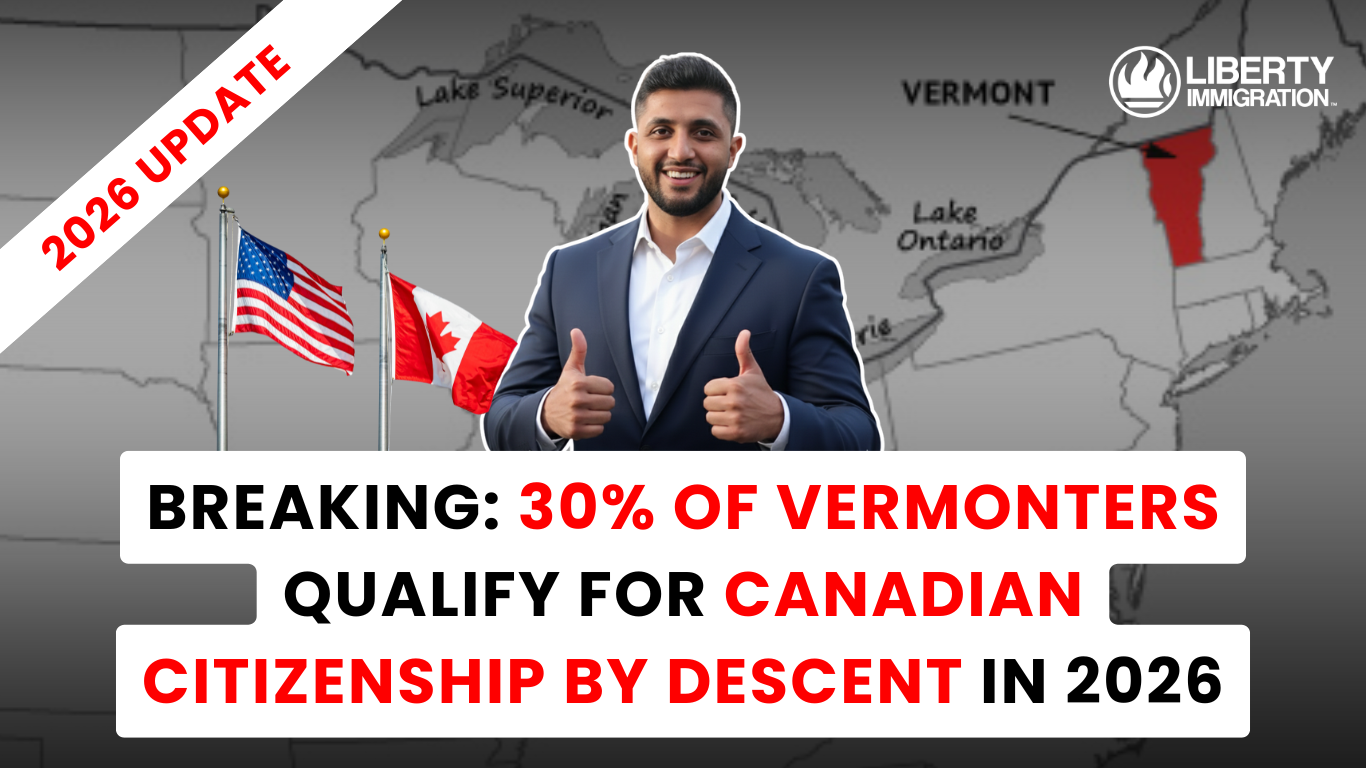
BREAKING: 30% of Vermonters Qualify for Canadian Citizenship by Descent in 2026
Executive Summary: The Vermont Citizenship Boom
In a historic legislative shift, Canada eliminated its first-generation limit on citizenship by descent on December 15, 2025. RCIC Vineet notes that this single legal change has disproportionately impacted one U.S. state more than any other: Vermont. Due to massive historical migration, an estimated one-in-three Vermonters are now legally recognized as U.S.-Canadian dual citizens. Here is how to claim your Canadian citizenship by descent Vermont 2026 status.
- The 30% Metric: According to the Vermont Genealogy Library, roughly 30% of Vermont residents have French-Canadian ancestry. If you trace your lineage to just a single Canadian ancestor and were born before December 15, 2025, you qualify.
- The Ultimate Backup Plan: The Canadian passport ranks higher than the U.S. passport on the Henley Passport Index. Acquiring it grants you the right to vote, run for office, and access healthcare (upon establishing residency) without triggering any Canadian worldwide taxation.
- Generational Wealth: Newly recognized citizens can pass this citizenship down to their own children born anywhere in the world, provided the parent has lived in Canada for at least three years.
- The Quebec Bottleneck: With a staggering 3,000% increase in historical record requests at Quebec's national archives, wait times have severely inflated. Hiring a Quebec-based representative is now critical to jumping the queue.
BREAKING: 30% of Vermonters Qualify for Canadian Citizenship by Descent in 2026
A new law has fundamentally rewritten the borders of citizenship across New England, creating a modern-day gold rush for the Canadian passport. On December 15, 2025, the Government of Canada officially eliminated the "first-generation limit" to inheriting citizenship. Today, if you can trace an unbroken line to a single Canadian ancestor—no matter how many generations removed—you are legally recognized as a Canadian citizen.
Nowhere is the impact of this law felt more profoundly than in Vermont. RCIC Vineet emphasizes that because of the state's deep historical ties to the province of Quebec, nearly one-in-three residents possess the required lineage to claim a Canadian citizenship by descent Vermont 2026 passport.
The vast majority of the Americans applying are not planning an immediate relocation to Montreal or Toronto. They are well-off, semi-retired professionals whose families have lived in the United States for generations, seeking the ultimate, tax-free "backup option" in an increasingly unpredictable world.
Do You Have a Canadian Ancestor? Book a Lineage Assessment Today1. The Demographics: Why Vermont is the Epicenter
To understand why Vermont is uniquely positioned to benefit from this law, one must look back to the mass migration between 1840 and 1930. During this period, an exodus of French-speaking Canadians moved south from Quebec into New England to work in local industries.
By 1860, more than 16,000 French Canadians had settled in Vermont—a figure that was more than double the number of any other New England state at the time, according to historical data from Vermont Public. Today, Ed McGuire, former president of the Vermont Genealogy Library, estimates that a staggering 30% of modern Vermont residents have French-Canadian ancestry.
If you grew up with French as a first or second language in the home, or if your family bears a distinctively French-Canadian surname—such as Pelletier, LaFlamme, Martel, Ouellette, or LeClair—these are incredibly strong indicators that you are eligible.
2. The Unmatched Benefits of the Canadian Passport
Claiming your Canadian citizenship by descent Vermont 2026 status is not just a nod to your heritage; it is a massive geopolitical advantage. Both the United States and Canada fully permit dual citizenship, allowing you to enjoy the absolute rights and privileges of both nations simultaneously.
- Superior Travel Mobility: The Canadian passport currently ranks above the U.S. passport on the prestigious Henley Passport Index, granting wider visa-free global access.
- Zero Tax Penalties: Unlike the United States, Canada does not enforce a worldwide tax on its citizens. You gain the passport without gaining a tax bill. For Americans, claiming Canadian citizenship carries absolutely no financial downsides.
- Generational Legacy: Under the new rules, you can pass your Canadian citizenship by descent to your own children born anywhere in the world, provided you have lived in Canada for at least three years.
- Youth Mobility Programs: Canadian passport holders under the age of 35 gain access to Canada's coveted Youth Mobility agreements, allowing them to legally live and work across dozens of countries in Europe, South America, Asia, and Oceania.
3. The Archival Nightmare: Obtaining Quebec Records
It is important to note: you are not applying to become a citizen. Under the law, you already are one. You are simply applying to Immigration, Refugees and Citizenship Canada (IRCC) for a "Proof of Canadian Citizenship" certificate.
To do this, you must collect historical documentation—birth certificates, death certificates, baptismal records, hospital records, and marriage certificates—proving the unbroken chain of connection to your French-Canadian ancestor.
Because the vast majority of these ancestors originated in Quebec, you must request these historical vital records from Quebec’s national archives, the Bibliothèque et Archives nationales du Québec (BAnQ).
Since the law changed in December 2025, demand for these documents has completely overwhelmed the system. The BAnQ has reported a massive 3,000% increase in requests for vital records proving ancestry.
The Strategic Solution: RCIC Vineet strongly advises against Americans submitting these requests themselves. The BAnQ legally prioritizes requests made by residents of Quebec. By hiring a Quebec-based licensed representative (such as an immigration lawyer or RCIC operating in the province), eligible Vermonters can effectively jump the archival queue and secure their essential documentation months faster.
4. The Processing Timeline: 10 Months to Freedom
Once your representative has collected the required civil documents, the application is submitted to IRCC. Here is the reality of the 2026 timeline:
| The Application Step | Current Processing Time | What You Receive |
|---|---|---|
| Step 1: Proof of Citizenship | 10 Months | An official Proof of Canadian Citizenship Certificate from IRCC. |
| Step 2: Passport Issuance | 10 to 20 Business Days | A physical Canadian Passport. (The government provides a 30-day money-back guarantee on this processing time). |
Don't Wait for Processing Times to Worsen
With a 3000% surge in archival requests, the queue is only getting longer. Let our licensed RCIC team bypass the BAnQ bottleneck and secure your family's Proof of Citizenship application flawlessly.
Start Your Canadian Citizenship ClaimTop 20 FAQs: Claiming Canadian Citizenship in Vermont
The elimination of the first-generation limit has generated massive interest across New England. Here are 20 highly specific, Reddit-popular FAQs regarding the Canadian citizenship by descent Vermont 2026 process.
1. Does the December 2025 law mean anyone can become Canadian?
No. It strictly applies to individuals born prior to December 15, 2025, who can prove a direct, unbroken biological or legally adopted bloodline to a recognized Canadian citizen.
2. What if my Canadian ancestor is my great-great-grandfather?
You are eligible. The new law completely eliminated the generational limit. As long as you have the continuous civil documents proving the parent-child relationship at every generation back to that ancestor, you qualify.
3. Can I use Ancestry.com DNA results to prove my descent?
Absolutely not. IRCC does not accept commercial DNA tests to establish citizenship. You must provide official, government-issued vital records (birth, marriage, and death certificates).
4. How does the BAnQ prioritize document requests?
Due to the 3000% surge in demand, the Bibliothèque et Archives nationales du Québec internal routing prioritizes requests filed by residents physically living inside the province of Quebec over international requests from the US.
5. Will I have to pay Canadian income taxes if I live in Vermont?
No. Canada taxes based on residency, not citizenship. As long as you maintain your primary residence in Vermont and do not establish significant financial ties in Canada, you owe zero Canadian income tax.
6. Will I lose my US citizenship if I claim my Canadian one?
No. The United States fully allows its citizens to hold dual nationality. Claiming your inherent Canadian citizenship by descent will not jeopardize your US passport or rights.
7. What is the youth mobility program?
International Experience Canada (IEC) allows Canadian citizens under the age of 35 to obtain special working holiday visas in over 30 partner countries across Europe, Asia, and Oceania, allowing them to easily travel and work abroad.
8. How do I pass my newly claimed citizenship to my future children?
Under the new rules, if your children are born outside Canada, you can only pass your citizenship down to them if you can prove you have physically resided in Canada for at least three cumulative years (1,095 days) prior to their birth.
9. Are Catholic baptismal records legally accepted by IRCC?
Yes. In Quebec, civil registration was historically managed by the church prior to 1994. IRCC officially accepts historical parish baptismal and marriage records as primary proof of parentage.
10. Can I apply for the passport directly?
No. You cannot apply for a Canadian passport until you first possess the official Proof of Canadian Citizenship certificate issued by IRCC, which currently takes 10 months to process.
11. Why does the Canadian passport rank higher than the US passport?
According to the Henley Passport Index, the Canadian passport offers slightly greater global mobility due to Canada's favorable geopolitical standing, granting visa-free or visa-on-arrival access to slightly more countries.
12. Do I need an apostille on my Vermont birth certificate?
Generally, no. IRCC accepts certified, state-issued vital records from the United States without requiring the additional step of a Hague Apostille.
13. Does my Canadian ancestor need to have spoken French?
No. While a large percentage of the migration to Vermont was French-Canadian, the citizenship law applies equally regardless of whether your ancestor was Anglophone, Francophone, or Indigenous.
14. What if my ancestor's name was changed or Americanized at the border?
Name changes are a frequent complication (e.g., 'Boulanger' to 'Baker'). You must provide connecting legal documents, such as marriage certificates or court affidavits, proving that the Canadian individual and the Americanized individual are the exact same person.
15. Do I get free healthcare in Canada once I get my passport?
Not immediately. Canadian healthcare is administered by the provinces based on residency, not citizenship. You must physically move to a Canadian province and live there for a waiting period (usually 3 months) before you are eligible for provincial Medicare.
16. What is the 30-day money-back guarantee for passports?
The Canadian government guarantees standard passport processing within 10 to 20 business days. If they fail to meet their own processing timeline standards, you are eligible to request a refund of the passport fee.
17. Is there a fee to apply for the Proof of Citizenship certificate?
Yes. The government processing fee for an Application for a Citizenship Certificate (Proof of Citizenship) is currently $75 CAD per applicant, independent of representative or archival fees.
18. Can I apply online or must it be paper?
If your ancestor is multiple generations removed and you are applying from outside of Canada with complex historical documentation, IRCC will most likely require you to submit a physical paper application package to the processing center in Nova Scotia.
19. Can I run for political office in Canada if I've never lived there?
Yes. Canadian citizens have the constitutional right to vote in federal elections and run for federal political office, even if they obtained their citizenship by descent and live abroad.
20. What happens if I make a mistake on the application?
If your application is returned as incomplete or refused due to insufficient connecting evidence, you lose your 10-month wait time. You will have to fix the errors and re-submit to the back of the 50,000-person queue.
Trending 2026 Canadian Citizenship Updates
- A third of Vermonters can get Canadian passports in wake of citizenship law changes
- New law gives thousands of Bay Staters claim to Canadian passports
- Could Canada’s new citizenship law help U.S. draft dodgers?
- As droves of Americans apply for proof of Canadian citizenship, processing times have doubled
© 2026 Liberty Immigration. All rights reserved. | Book a Consultation
Related Blogs:


Written By
Vineet Tiwari
Vineet is a caring and creative leader who has lived in India, Oman, UAE, and Canada, giving him a rich multicultural perspective. His commitment to physical fitness keeps him energetic and focused. Vineet's dedication to his clients is evident as he often takes calls on weekends, ensuring they always feel supported and valued. His diverse background and unwavering availability help build strong, trusting relationships with our clients.
