
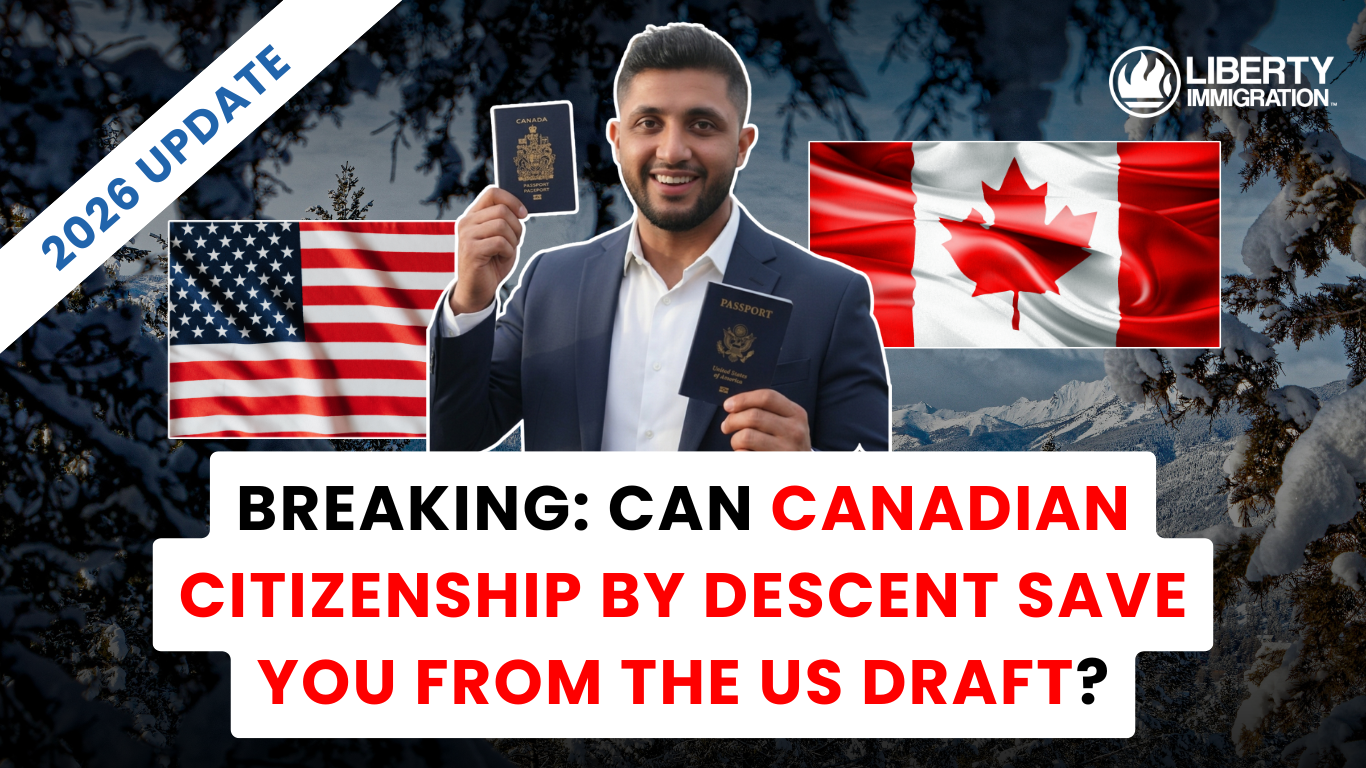
BREAKING: Can Canadian Citizenship by Descent Save You From the US Draft?
Executive Summary: The 2026 Border Pivot
Hello! I am RCIC Vineet. With the United States set to resume mandatory draft registration this coming December, families across America are urgently exploring their legal options. Simultaneously, Canada’s historic December 2025 Citizenship Act changes have granted millions of Americans the unconditional right to enter Canada. The intersection of these two events has sparked a massive surge in applications for Canadian citizenship by descent US draft contingencies.
- The Mandatory Registration: Starting this December, all American men aged 18 to 26 will be automatically registered for the U.S. military draft.
- The Canadian Safe Haven: Because Canada eliminated the generational limit to inheriting citizenship last December, millions of these young men are already legally recognized as U.S.-Canadian dual citizens—granting them guaranteed entry to Canada for life.
- The Vietnam Precedent: During the Vietnam War, 50,000 draft-age Americans crossed into Canada. Under Prime Minister Pierre Trudeau, border officials were instructed not to ask about U.S. military status.
- The Current Gold Rush: Surprisingly, the current wave of 50,000+ applicants overwhelming the 10-month processing queue isn't young men—it is older, well-to-do professionals securing backup plans for their families.
BREAKING: Can Canadian Citizenship by Descent Save You From the US Draft?
A storm is brewing at the intersection of American military policy and Canadian immigration law. This December, the United States is officially set to resume automatic, mandatory draft registration for millions of young American men aged 18 to 26.
Simultaneously, a monumental change to Canada's Citizenship Act enacted in December 2025 has created a massive legal loophole. By removing the strict generational limits on inheriting Canadian citizenship, millions of Americans with even a single Canadian ancestor—regardless of how many generations removed—are now legally recognized as U.S.-Canadian dual citizens.
RCIC Vineet notes that this means millions of draft-eligible American men currently possess the unconditional, guaranteed right to cross the northern border, obtain a Canadian passport, and live in the "land of hockey sticks and maple syrup" for the rest of their lives. But the reality of acquiring Canadian citizenship by descent US draft protection is bureaucratically complex. Here is exactly what is happening on the ground in 2026.
Are You Eligible for Dual Citizenship? Book a Lineage Assessment Today1. The Vietnam War Precedent vs. The 2026 Reality
The concept of Americans looking north during times of military conscription is not new. During the Vietnam War era, approximately 50,000 draft-age American men crossed the border into Canada seeking refuge.
At that time, obtaining a Canadian passport wasn't even necessary. The government, led by Prime Minister Pierre Trudeau, issued strict instructions to Canadian border officials: they were not to inquire about the U.S. military status of arriving Americans. Thousands were allowed into Canada simply on their word or by showing a basic birth certificate.
In 2026, the border is much more heavily regulated. However, for those claiming Canadian citizenship by descent US draft protections, a border agent's discretion doesn't matter. If you hold a Proof of Canadian Citizenship certificate and a Canadian passport, you have the absolute constitutional right to enter and remain in Canada indefinitely. You cannot be denied entry.
2. The Legal Trap: Dual Citizenship and Draft Laws
While Canada offers a physical safe haven, RCIC Vineet emphasizes that dual citizenship does not legally erase your American obligations.
U.S.-Canadian dual citizens enjoy the full rights, privileges, and protections of both nations. However, they are also fully subject to the laws of both countries. If the U.S. government enacts draft provisions, an American holding a Canadian passport is still legally bound by U.S. law. The key difference is that moving to Canada puts you outside the immediate, physical jurisdiction of the U.S. authorities.
3. Who is Actually Applying Right Now? (The 50,000 Queue)
While the looming December automatic draft registration has sparked frantic Google searches among 18-to-26-year-olds, the reality of the applicant pool tells a different story.
This spring, the thousands of Americans aggressively applying for Proof of Canadian Citizenship certificates are not young men fleeing conscription. The demographic is heavily skewed toward older, well-to-do professionals.
| Applicant Demographic | Primary Motivation in 2026 |
|---|---|
| Retired Doctors, Lawyers & Tech Workers | Securing the passport as an ultimate "back-up plan" due to political or social instability. |
| Wealthy Entrepreneurs | Valuing geographical options and establishing dual status for multi-generational wealth planning. |
| Parents of Draft-Age Men | Securing their own citizenship certificates first, so they can subsequently pass the recognized status to their 18-to-26-year-old sons. |
4. The Bureaucratic Nightmare: A 10-Month Delay
If you or your son needs to secure Canadian citizenship by descent US draft options quickly, you are already behind schedule. The surge of wealthy professionals securing their backup plans has completely overwhelmed the system.
Today, there are more than 50,000 applications sitting in the processing queue. Because millions of Americans are technically eligible (even if their family has lived in the U.S. for four, five, or six generations, provided they were born before December 15, 2025), the line is growing exponentially.
The processing time for a Proof of Canadian Citizenship certificate has officially doubled, surging from 5 months to 10 months.
5. Overcoming the Archival Bottleneck in Quebec
Applying requires submitting a complex paper application to Canada's citizenship department, complete with official vital records proving your unbroken ancestry. The most agonizing roadblock is acquiring these historical documents.
Many Americans trace their lineage back to French-Canadian immigrants. Obtaining copies of required documents from regional authorities, such as the province of Quebec's Directeur de l’état civil (DEC), has become a massive bottleneck.
Canadian provincial archives are heavily prioritizing document requests originating from actual Canadian residents. To bypass the massive delays, smart American applicants are hiring professional, Canada-based legal representatives (like RCICs) to request these vital records on their behalf.
Don't Wait in the 50,000-Person Queue Blindly
With processing times hitting 10 months and the US draft registration looming this December, your application must be legally flawless to avoid rejection. Let our Canada-based RCIC team procure your archival documents and fast-track your submission.
Secure Your Canadian Dual Citizenship NowTop 20 FAQs: Canadian Citizenship by Descent and the US Draft
The combination of military draft anxieties and complex inheritance laws has generated massive confusion online. Here are the 20 most frequently asked questions regarding the Canadian citizenship by descent US draft reality in 2026.
1. Does having Canadian citizenship exempt me from the US draft?
No. If you are a dual US-Canadian citizen, you are still legally bound by US law. Being a dual citizen does not grant you a legal exemption from US selective service or draft provisions.
2. If I move to Canada, can the US extradite me for draft dodging?
Historically, during the Vietnam War, Canada did not extradite draft evaders because military offenses are typically not considered extraditable crimes under international extradition treaties. However, legal frameworks can evolve.
3. When does the automatic US draft registration start?
According to current legislative updates, automatic, mandatory draft registration for American men aged 18 to 26 is set to resume this December.
4. Do I need to renounce my US citizenship to avoid the draft?
Renouncing US citizenship is a complex, irrevocable, and highly taxed legal process. While it removes you from US jurisdiction, doing it solely to evade military service can permanently bar you from ever re-entering the US.
5. What did the December 2025 Canadian law actually change?
The December 2025 amendment removed the 'first-generation limit.' Previously, Canadians born abroad could not pass citizenship to their foreign-born children. Now, an unbroken line of ancestry to a Canadian grants citizenship to anyone born before December 15, 2025.
6. Will Canada stop draft dodgers at the border in 2026?
If you hold a valid Proof of Canadian Citizenship certificate and a Canadian passport, you have an absolute constitutional right to enter Canada. Border agents cannot deny entry to a recognized Canadian citizen.
7. What is the Directeur de l’état civil (DEC)?
The DEC is the provincial authority in Quebec responsible for civil status records. Because many Americans trace their roots to Quebec, they face massive delays trying to extract historical birth and marriage certificates from this agency.
8. Can my 18-year-old son apply for a Canadian passport without me applying?
Yes, provided he can supply the unbroken chain of vital records tracing his lineage back to the Canadian ancestor. However, it is often easier if the parent claims their status first to establish the immediate link.
9. Why did the processing time jump to 10 months?
Following the law change, IRCC was inundated with applications from Americans realizing their eligibility. The queue currently sits at over 50,000 applications, doubling the processing time from 5 to 10 months.
10. Can the US government see that I applied for Canadian citizenship?
Canada does not proactively inform the US government when a US citizen applies for proof of Canadian citizenship. However, utilizing the passport internationally leaves a data trail.
11. If I have a Canadian certificate, do I need a visa to enter Canada?
No. A Proof of Canadian Citizenship certificate legally proves your status. However, to board a commercial flight to Canada, you must possess a physical Canadian passport.
12. Will Pierre Trudeau's Vietnam-era policies apply today?
Trudeau's policies were a product of the Vietnam era. While modern Canadian border policies are stricter, recognized dual citizens are immune to border rejections, negating the need for special political exemptions.
13. Does Canada have a military draft?
No. Canada does not have mandatory military service or a draft system. The Canadian Armed Forces are strictly an all-volunteer military force.
14. Can I get a Canadian passport if my ancestor was from Nova Scotia, not Quebec?
Absolutely. The citizenship by descent law applies to ancestors from any Canadian province or territory, not just Quebec.
15. What if my Canadian ancestor lost their citizenship historically?
Canada has implemented several legislative updates to restore citizenship to those who lost it (often women who married foreigners). An RCIC can determine if your ancestor's status was restored, making you eligible.
16. Is the 50,000 application queue just for Americans?
While a massive portion of the queue consists of Americans due to geographical proximity, the 50,000 backlog includes people globally claiming citizenship by descent under the new laws.
17. Are Canadian archives rejecting US requests?
They are not rejecting them outright, but they are heavily prioritizing requests from Canadian residents. This is why hiring a Canada-based representative is highly recommended to speed up the document procurement process.
18. Does obtaining Canadian citizenship trigger US expatriation taxes?
No. Claiming dual citizenship by descent does not trigger the US exit tax. That tax is only levied if you formally, legally renounce your US citizenship and meet certain wealth thresholds.
19. Can I just drive to Canada with my birth certificate like in Vietnam?
No. Border security in 2026 requires standard travel documents. You must have an approved Proof of Citizenship certificate to prove your status; a simple US birth certificate will only grant you entry as a temporary visitor.
20. How do I prove a 4th-generation connection to IRCC?
You must provide an unbroken chain of long-form birth certificates and marriage certificates from you, to your parent, to your grandparent, all the way back to the Canadian ancestor, linking the parentage at each step.
Trending 2026 Canadian Citizenship Updates
- Could Canada’s new citizenship law help U.S. draft dodgers?
- New law grants Canadian citizenship to millions of Americans: are their spouses and children also US-Canadian dual citizens?
- As droves of Americans apply for proof of Canadian citizenship, processing times have doubled
- Understanding the PNP Draw: How to Secure a 600-Point Bonus in 2026
© 2026 Liberty Immigration. All rights reserved. | Book a Consultation
Related Blogs:



Written By
Vineet Tiwari
Vineet is a caring and creative leader who has lived in India, Oman, UAE, and Canada, giving him a rich multicultural perspective. His commitment to physical fitness keeps him energetic and focused. Vineet's dedication to his clients is evident as he often takes calls on weekends, ensuring they always feel supported and valued. His diverse background and unwavering availability help build strong, trusting relationships with our clients.
