
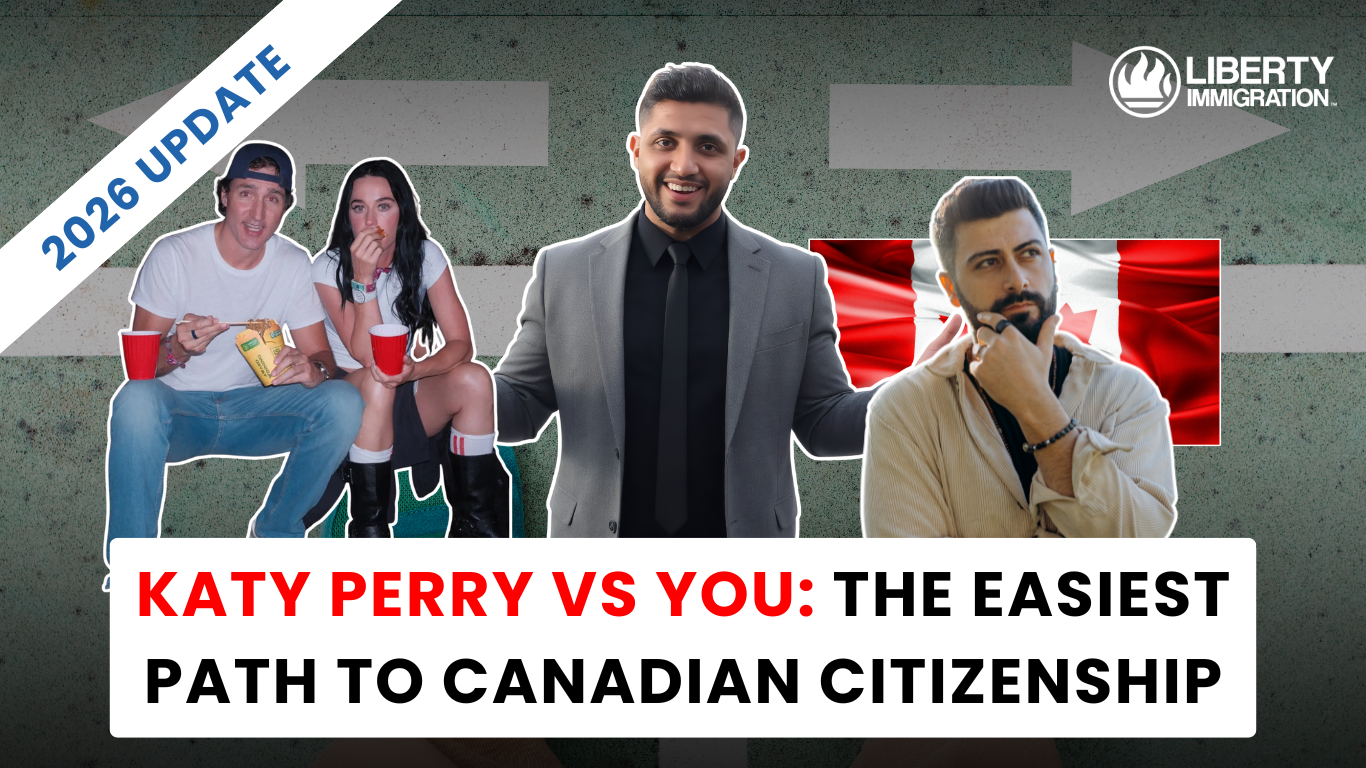
Katy Perry vs You: The Easiest Path to Canadian Citizenship
Executive Summary: Citizenship by Descent
Hello! I am RCIC Vineet. While pop star Katy Perry made headlines recently for her high-profile connection to Canada, the truth is that millions of ordinary Americans have a much faster, easier route to a Canadian passport through Canadian citizenship by descent.
- The Famous Route: Without Canadian blood, celebrities like Katy Perry face years of immigration processing and residency requirements.
- The "Secret" Route: Thanks to Bill C-3, enacted in December 2025, anyone with a Canadian ancestor can claim citizenship instantly by proving their lineage.
- The Demand: Canadian archives are experiencing a 3,000% increase in record requests as Americans rush to uncover their Canadian roots.
- The Result: You don't need to immigrate or take a test. You simply apply for a Proof of Citizenship certificate to secure your Canadian passport.
Katy Perry’s Path to Canadian Citizenship: Date a Prime Minister. Yours: Check Your Family Tree
Katy Perry and former Canadian Prime Minister Justin Trudeau broke the internet this weekend at Coachella. From holding hands between sets, to swaying together during Justin Bieber's headline performance, and posting couple photos to Perry's 260 million Instagram followers, the internet had a lot of opinions.
But buried in the noise of celebrity gossip is a fascinating immigration question: could Katy Perry actually become a Canadian citizen?
The short answer is: not easily. And ironically, millions of ordinary Americans have a much faster, cheaper, and simpler path to a Canadian passport than one of the world's biggest pop stars. As a Regulated Canadian Immigration Consultant (RCIC), let me explain how Canadian citizenship by descent works, and why your family tree might be more valuable than a high-profile romance.
Check Your Eligibility for Canadian Citizenship Today1. The Celebrity Roadblock: Why Katy Perry Can't Easily Become Canadian
To become a Canadian citizen, you generally need two things: either Canadian blood or years of Canadian residency. Katy Perry has neither.
Perry's ancestry is a mix of English, German, Irish, and Portuguese, firmly rooted in California, the American South, and the Azores. There is no Canadian branch in her family tree. Because she lacks Canadian citizenship by descent, her only path to a passport would run directly through Trudeau himself via spousal sponsorship.
Spousal sponsorship is not a VIP fast track. It requires a formal, lengthy application, intense background checks, and most importantly, physical residency in Canada. Even as a celebrity, Perry would have to live in Canada for at least three out of five years as a Permanent Resident before she could even apply for citizenship. In short: one of the most famous women in the world would have to endure a grueling, multi-year immigration process.
2. The Legal Loophole: Bill C-3 and Citizenship by Descent
Meanwhile, millions of ordinary Americans are already Canadian citizens, and most of them have absolutely no idea.
On December 15, 2025, the Canadian government enacted Bill C-3. This revolutionary piece of legislation completely abolished the "first-generation limit," a restrictive rule that previously stopped Canadians from passing their citizenship down to children born abroad.
Under the new laws of Canadian citizenship by descent, there is no generational limit for anyone born before December 15, 2025. If you can trace your lineage back to a single Canadian ancestor—whether it is a parent, grandparent, or a great-great-grandparent who left Quebec in 1890—you are legally considered a Canadian citizen today.
Unlike Katy Perry, you do not need to apply to become a citizen. You do not need to take a language test, pass a history exam, or live in Canada for three years. You simply apply for a certificate that proves what you already are.
3. The Great Document Gold Rush of 2026
The realization that millions of Americans qualify for Canadian citizenship by descent has triggered a massive gold rush for historical documents. To claim your passport, you must provide Immigration, Refugees and Citizenship Canada (IRCC) with an unbroken paper trail linking you to your Canadian ancestor.
This means hunting down 100-year-old birth certificates, marriage licenses, and baptismal records. The demand is so intense that provincial archives across Canada have been completely overwhelmed. Quebec alone reported a 3,000% increase in archival record requests from Americans searching for their roots.
If your family has roots in New England, upstate New York, Michigan, Minnesota, Wisconsin, or Louisiana, there is an exceptionally high chance a Canadian ancestor is hiding in your tree. If your last name was once spelled differently (like Leblanc becoming White), or if older relatives spoke French, the odds go up significantly.
Claim Your Secret Citizenship
Don't let complex archival research stop you from securing a second passport. Our licensed experts specialize in tracing lineage and securing Proof of Citizenship certificates.
Consult With a Citizenship Expert Today4. How to Claim Your Canadian Passport
If you believe you qualify for Canadian citizenship by descent, the process is straightforward, though currently delayed by high application volumes.
- Gather Your Proof: You must collect the vital statistics records linking you to your Canadian ancestor.
- Apply for Proof of Citizenship: You submit these documents, along with the required IRCC forms, to the Canadian government.
- Wait for Processing: Due to the unprecedented demand sparked by Bill C-3, processing times for Proof of Citizenship applications are currently stretching to about 10 months.
- Apply for Your Passport: Once you receive your official Citizenship Certificate, you can apply for a Canadian passport at any consulate.
Katy Perry might need a former Prime Minister to get a Canadian passport. You might just need a birth certificate.
5. Top 15 FAQs: Canadian Citizenship by Descent
The internet is buzzing with questions about this new pathway. Here are the top 15 questions regarding Canadian citizenship by descent answered by an RCIC.
1. What is Canadian citizenship by descent?
Canadian citizenship by descent allows individuals born outside of Canada to inherit citizenship automatically through their bloodline, provided they can prove an unbroken chain of ancestry to a recognized Canadian citizen.
2. How did Bill C-3 change the rules?
Enacted in December 2025, Bill C-3 abolished the "first-generation limit," meaning citizenship can now be passed down through multiple generations born outside of Canada, provided the applicant was born before December 15, 2025.
3. How far back can my Canadian ancestry go?
There is no generational limit. Whether your Canadian ancestor is a parent, a grandparent, or a great-great-grandparent who left Canada in the 1800s, you can still claim Canadian citizenship by descent.
4. Do I have to take a Canadian citizenship test?
No. Because you are claiming citizenship by descent, you are already a citizen by birthright. You do not need to take a knowledge test or swear an oath of citizenship.
5. Do I need to move to Canada to keep my passport?
No. There is no residency obligation for citizens by descent. You can obtain your Canadian passport and continue living in the United States or anywhere else in the world.
6. Will I lose my US citizenship if I become Canadian?
No. Both the United States and Canada fully recognize dual citizenship. Claiming your Canadian passport will not affect your status as a US citizen.
7. What documents do I need to prove my ancestry?
You must provide an unbroken paper trail of government-issued vital records, specifically long-form birth certificates and marriage certificates, linking you directly to your Canadian ancestor.
8. Can I use Ancestry.com DNA results as proof?
No. IRCC strictly requires official, government-issued civil documents. Commercial DNA tests are not accepted as legal proof of Canadian citizenship by descent.
9. How long does the application process take in 2026?
Due to a massive surge in applications following the Bill C-3 changes, processing times for Proof of Citizenship applications currently average about 10 months.
10. Do I have to pay Canadian taxes if I live in the US?
Unlike the US, Canada taxes based on residency. If you claim your Canadian citizenship but continue to live and work exclusively in the US, you do not owe Canadian income tax.
11. Can my children get Canadian citizenship too?
Yes, if your children were born before December 15, 2025, they can also claim citizenship. If born after, you must prove you spent at least 1,095 days in Canada before their birth to pass it on.
12. Do I get free healthcare if I claim my citizenship?
Not automatically. Canadian healthcare is managed by the provinces and requires physical residency. You must actually move to Canada and live there (usually for 3 months) to qualify for coverage.
13. What if my ancestors changed their name when they moved to the US?
This is common (e.g., Leblanc to White). As long as you can provide legal documentation or vital records that bridge the name change between generations, you remain eligible.
14. What is a Proof of Citizenship certificate?
It is the official IRCC document confirming you are legally a Canadian citizen. You must secure this certificate before you are allowed to apply for a Canadian passport.
15. Why should I hire an RCIC for this process?
Proving multi-generational descent requires flawlessly presenting archival documents to IRCC. A licensed RCIC ensures your package meets strict legal standards, avoiding 10-month delays or outright refusals.
Trending 2026 Canadian Immigration Updates
- 25% of New Englanders can get Canadian passports, in wake of citizenship law changes
- Why Cajuns may be Canadians under new citizenship law
- The Canadian passport now outranks the US passport — and many Americans may already have a claim to one
- Americans with one of these 42 last names may be secret Canadians
© 2026 Liberty Immigration. All rights reserved. | Book a Consultation
Related Blogs:


Written By
Vineet Tiwari
Vineet is a caring and creative leader who has lived in India, Oman, UAE, and Canada, giving him a rich multicultural perspective. His commitment to physical fitness keeps him energetic and focused. Vineet's dedication to his clients is evident as he often takes calls on weekends, ensuring they always feel supported and valued. His diverse background and unwavering availability help build strong, trusting relationships with our clients.
