Generation Zero: Canadian Citizenship by Descent Without Born in Canada

📌 Direct Answer: Can You Claim Canadian Citizenship Without a Canadian-Born Ancestor?
YES. Your ancestor did NOT need to be born on Canadian soil to pass on Canadian citizenship by descent. Under Canadian nationality law, an immigrant ancestor who acquired Canadian status—whether as a British subject born before 1947, a naturalized citizen, or a landed immigrant with Canadian domicile—can act as the "Generation Zero" anchor for your citizenship claim.
Following the enactment of Bill C-3 on December 15, 2025, the First-Generation Limit (FGL) was retroactively removed for individuals born prior to that date. As long as your non-Canadian-born ancestor acquired Canadian status before the next generation in your family was born, you may hold an immediate statutory right to a Canadian Citizenship Certificate.
Generation Zero: Your Ancestor Didn’t Have to Be Born in Canada to Pass On Canadian Citizenship
When foreign nationals begin researching their family history to evaluate whether they qualify for Canadian citizenship, many operate under a widespread misconception: they assume that at least one ancestor in their direct vertical lineage must have been physically born in Canada. When they discover that their parent, grandparent, or great-grandparent was an immigrant born in Poland, the UK, or Italy, they often abandon their search.
However, that assumption is legally incorrect. Under Canadian nationality law, claiming **canadian citizenship by descent without born in canada** ancestors is fully recognized. Citizenship by descent relies on establishing an unbroken legal chain back to a "Generation Zero" ancestor—the foundational individual whose official Canadian status anchors the claim for every generation that follows.
As a leading cross-border advisory firm directed by Vineet Tiwari, a licensed Regulated Canadian Immigration Consultant (RCIC), Liberty Immigration routinely audits multi-generational family trees. This comprehensive legal guide explains the "Generation Zero" concept, details the four distinct non-birth pathways to Canadian status, analyzes case studies unlocked by Bill C-3, and outlines the primary evidence required by Immigration, Refugees and Citizenship Canada (IRCC).
Tracing a Naturalized or Immigrant Ancestor? Book an RCIC Lineage Assessment Today1. Defining "Generation Zero" in Canadian Nationality Law
In Canadian citizenship claims, "Generation Zero" refers to the root ancestor whose Canadian status supplies the legal link for all subsequent descendants. While birth on Canadian soil (jus soli) is the most familiar pathway, the *Citizenship Act* recognizes several alternative legal statuses that establish an ancestor as Generation Zero.
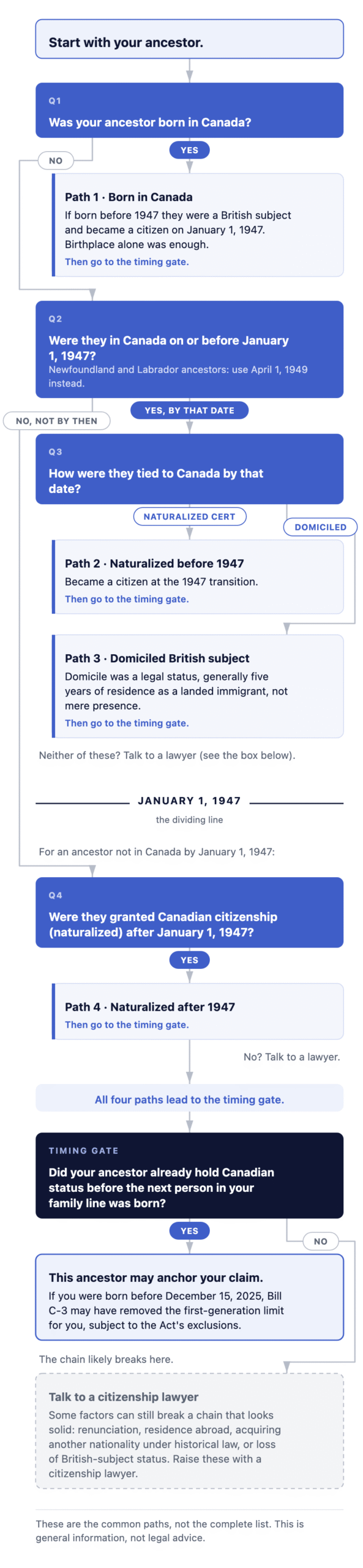
To pass citizenship down the line, the general legal requirement is that **the ancestor must have officially acquired Canadian status before the next generation in the family tree was born**.
| Generation Node | Family Role in Lineage Chain | Required Legal Status / Action |
|---|---|---|
| Generation Zero (Anchor) | Root Ancestor (Parent, Grandparent, Great-Grandparent) | Must hold valid Canadian status (Birth, Naturalization, or Domicile) before Gen 1 birth. |
| Generation One (Intermediate) | Parent or Grandparent born abroad | Inherited status at birth (*ex lege*) from Generation Zero. |
| Generation Two / Three (Applicant) | You (Born abroad prior to Dec 15, 2025) | Claim recognized under **Bill C-3 retroactive restoration**. |
2. The 4 Non-Birth Pathways to Becoming a "Generation Zero" Ancestor
If your ancestor was not physically born in Canada, they could still serve as your Generation Zero anchor through one of four primary statutory routes:
Pathway 1: Canadian Birth Before January 1, 1947 (British Subject Status)
Prior to January 1, 1947, Canadian citizenship did not exist as an independent legal category. Anyone born in Canada prior to 1947 held the legal status of a **British subject**. When the original *Canadian Citizenship Act* took effect on January 1, 1947, these individuals were automatically converted into Canadian citizens. Today, the *Citizenship Act* explicitly recognizes pre-1947 British subject status as a valid starting point for citizenship by descent claims.
Pathway 2: Naturalized in Canada Before January 1, 1947
Immigrants who arrived in Canada from Europe or elsewhere and completed formal naturalization before January 1, 1947, became naturalized British subjects in Canada. Under current law, this pre-1947 naturalization is treated as the legal equivalent of modern Canadian citizenship. Even if the ancestor subsequently left Canada before 1947, their naturalization anchors the lineage, provided it occurred prior to the birth of their child.
Pathway 3: British Subjects Residing in Canada on January 1, 1947 (Canadian Domicile)
A British subject (such as an immigrant from the UK, Ireland, or Australia) who was living in Canada on January 1, 1947, and had acquired **Canadian domicile** automatically became a Canadian citizen on that date. Under legacy laws, Canadian domicile required at least **five years of continuous residence in Canada as a landed immigrant**. This applies even if the person was born abroad.
Pathway 4: Naturalized or Granted Citizenship After January 1, 1947
Any immigrant ancestor who moved to Canada after January 1, 1947, and was formally granted Canadian citizenship serves as a valid Generation Zero ancestor. The critical timing factor is that their official naturalization date must precede the birth date of the child in the next generation.
Newfoundland and Labrador did not join the Canadian Confederation until March 31, 1949. Ancestors residing in or born in Newfoundland became Canadian citizens on March 31, 1949, rather than January 1, 1947. Lineages tracing through Newfoundland must evaluate eligibility against the 1949 cutoff date.
3. Case Study: How Post-1947 Naturalization Transmits Citizenship Down Generations
To understand how a non-Canadian-born ancestor transmits citizenship across multiple generations under Bill C-3, consider a real-world operational scenario:
• 1968: Tomasz Kowalski immigrates from Poland to Canada.
• 1974: Tomasz completes formal naturalization and receives a Canadian Citizenship Certificate.
• 1980: Tomasz moves to the US, where his daughter Maria is born. (Because Tomasz naturalized in 1974—6 years before Maria's birth—Maria inherited Canadian citizenship at birth).
• 1997: Maria's daughter, Anna, is born in the United States.
Legal Outcome Under Bill C-3: Under the former First-Generation Limit (2009–2025), Anna was cut off from claiming citizenship because Maria was born outside Canada. However, because Anna was born in 1997 (before December 15, 2025), **Bill C-3 retroactively recognized Anna as a Canadian citizen from birth**. Anna can apply for her Proof of Citizenship Certificate using her grandfather's 1974 naturalization certificate as Generation Zero.
To review the complete document package required to submit an application under Bill C-3, consult our detailed guide on the essential required documents for Canadian citizenship by descent.
4. Chain Breakers: Factors That Can Extinguish a Non-Birth Claim
While naturalized and domiciled ancestors provide valid anchor points, historical nationality laws contained specific "chain breakers" that could interrupt an otherwise valid lineage:
- Naturalization Occurring AFTER Child's Birth: If an immigrant parent naturalized in Canada after their child was born abroad, the child was born to a non-citizen and did not inherit status at birth.
- Formal Citizenship Renunciation: If an ancestor formally renounced their Canadian status prior to the next child's birth.
- Historical Foreign Naturalization Loss Rules: Prior to February 15, 1977, acquiring a foreign nationality could trigger automatic loss of Canadian status under legacy statutes, affecting timing checks.
Because historical timing gaps can alter a claim, each generation's birth and naturalization certificates must be forensically audited before filing.
5. Document Checklist for Naturalized Ancestor Claims
To prove a claim anchored by a naturalized or immigrant ancestor, IRCC requires specific primary documentation:
| Lineage Generation | Required Government Civil Document Proofs |
|---|---|
| Generation Zero (Ancestor) | Official Canadian Naturalization Certificate, Certificate of Canadian Citizenship, or formal IRCC Search of Citizenship Records. |
| Generation One (Parent) | Certified Long-Form Birth Certificate showing parents' full names and date of birth. |
| Generation Two (Applicant) | Certified Long-Form Birth Certificate + Government Photo ID + IRCC Photos. |
A standard birth or immigration landing record alone is generally insufficient to prove naturalization. If your family lost your ancestor's physical naturalization certificate, you must request a formal Search of Citizenship Records through IRCC.
For detailed rules on ordering archival records from Quebec, consult our guide on mastering Quebec's pre-1994 record rules for citizenship claims. You can also review how to draft an effective Canadian citizenship by descent cover letter.
To explore how uncertified family documents are evaluated by IRCC officers, read proving Canadian citizenship with uncertified family records. If you hold American ties, review claiming citizenship when your parent had no Canadian passport, or learn how to renew a Canadian passport online.
Verify Your Immigrant Ancestor Lineage Under Licensed RCIC Supervision
Proving Canadian citizenship by descent through a naturalized or domiciled Generation Zero ancestor requires precise historical timing verification and civil record sourcing. A single missing naturalization paper or unverified birth sequence will cause your application package to be returned unprocessed. Let Vineet Tiwari, a fully licensed Regulated Canadian Immigration Consultant (RCIC), audit your family tree, verify your ancestor's naturalization dates, and manage your Proof of Citizenship submission safely.
Book Your Priority Generation Zero Lineage Audit Session NowFrequently Asked Questions (FAQs)
1. Can I get Canadian citizenship if my ancestor was an immigrant and not born in Canada?
Yes. If your ancestor naturalized in Canada, held British subject status before 1947, or had established Canadian domicile on January 1, 1947, prior to the next child's birth, they qualify as a Generation Zero anchor.
2. What is "Generation Zero" in Canadian citizenship claims?
"Generation Zero" refers to the foundational root ancestor whose official Canadian status supplies the legal link for all subsequent generations in a citizenship by descent claim.
3. What is the cut-off date for ancestors in Newfoundland and Labrador?
Newfoundland and Labrador joined Confederation on March 31, 1949. Ancestors from Newfoundland acquired Canadian citizenship on March 31, 1949, rather than January 1, 1947.
4. What document proves an immigrant ancestor became a Canadian citizen?
An official Canadian Citizenship Certificate, Naturalization Certificate, or a formal IRCC Search of Citizenship Records confirmation. A standard birth or immigration landing record alone is insufficient.
5. How long does IRCC take to process a Proof of Citizenship application in 2026?
Official central processing wait times for a Proof of Canadian Citizenship Certificate (Form CIT 0001) average approximately 19 months.
Social Share :
Related Blogs: