
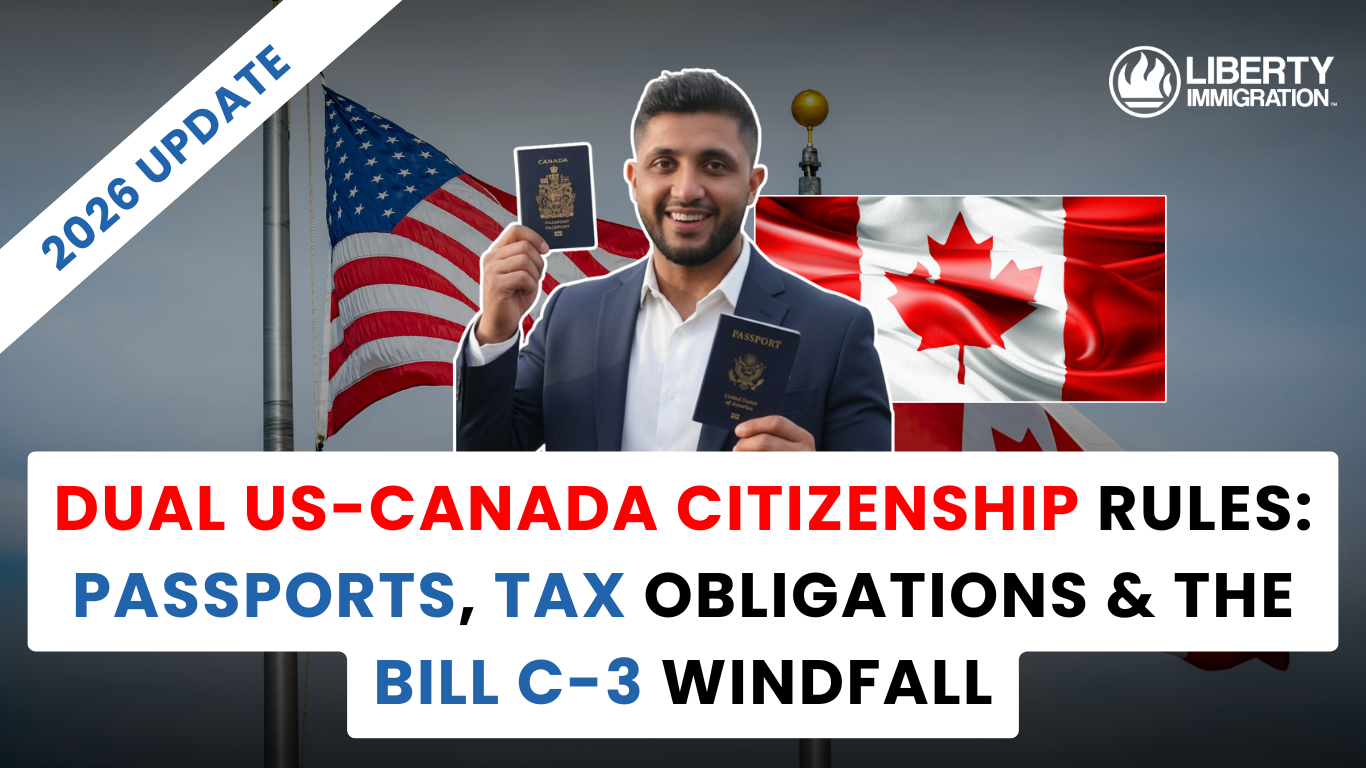
Dual US-Canada Citizenship Rules: Passports, Tax Obligations & The Bill C-3 Windfall
Executive Summary: Navigating Dual Sovereign Status
Holding status across both Canada and the United States unlocks significant opportunities for cross-border families, but it demands strict compliance with two completely separate legal frameworks[cite: 1]. Understanding the official dual us canada citizenship rules is essential to manage mandatory border-crossing laws, optimize global tax filings, and maximize your generational assets[cite: 1]. RCIC Vineet outlines the core regulatory thresholds for 2026:
- Mutual Sovereign Recognition: Both Washington and Ottawa fully permit dual status; neither country requires you to renounce your existing passport when claiming the other[cite: 1].
- Mandatory Border Controls: Dual citizens are legally required to present their valid US passport to enter the United States[cite: 1], and their valid Canadian passport to fly into or transit through Canada[cite: 1].
- Divergent Tax Models: While the IRS enforces worldwide taxation on all citizens regardless of where they live[cite: 1], Canada taxes individuals strictly based on physical residency—meaning non-resident status protects you from Canadian tax liabilities[cite: 1].
- The Bill C-3 Ancestry Path: For individuals born abroad before December 15, 2025, Canada's updated laws allow you to claim status through your grandparents or further back with zero generational limits[cite: 1].
Dual US-Canada Citizenship Rules: Passports, Tax Obligations & The Bill C-3 Windfall
For cross-border families, professionals, and retirees, securing dual nationality between the United States and Canada stands as one of the most stable and advantageous portfolio expansions available globally. Holding both passports grants you an unrestricted lifetime right to live, work, invest, and vote across two of the world's most prosperous economies[cite: 1]. However, navigating this dual status requires moving past generic travel tips and mastering the explicit legal guidelines enforced by both nations[cite: 1].
The operational landscape has shifted dramatically following the formal implementation of Bill C-3[cite: 1]. By permanently deleting Canada's old "first-generation limit" on status inheritance, the federal government has opened up an automatic path to nationality for millions of American residents who trace their roots back through Canadian grandparents or great-grandparents[cite: 1]. Yet, activating these dual us canada citizenship rules means you must carefully manage specific travel control laws and understand how the IRS and the Canada Revenue Agency (CRA) treat your worldwide wealth[cite: 1].
As a Regulated Canadian Immigration Consultant (RCIC), I regularly guide families through archival record tracing and cross-border settlement strategies. Failing to understand your dual obligations can result in border delays or compliance issues with tax authorities. Below is your definitive operational manual tracking passport control mandates, divergent tax rules, and active acquisition tracks for 2026.
Optimizing Your Cross-Border Status Strategy? Schedule a Professional Consultation Session1. The Legal Foundation: Mutual Recognition Without Renunciation
A frequent concern for Americans exploring their family tree is whether claiming a second status will jeopardize their existing U.S. passport. Under the formal cross-border guidelines, both Canada and the United States fully recognize and allow dual nationality[cite: 1]. Neither sovereign state requires you to renounce your birthright or legal status when acquiring the other[cite: 1].
It is vital to note that you do not "apply" for a generic dual-citizenship certificate. Rather, dual nationality is a legal status that occurs naturally when more than one country independently recognizes you as a citizen under their domestic laws. You simply apply for your separate national credentials—such as an IRCC citizenship certificate or a U.S. naturalization document—and maintain both identities concurrently[cite: 1].
2. Cross-Border Passport Control: The Strict Travel Mandates
While holding dual nationality grants you immense flexibility, it completely eliminates your option to choose which passport to present at the border. Both nations enforce strict border control laws that mandate how dual citizens must enter their respective territories:
The Mandatory Passport Presentation Rules:
• Entering Canada: Under federal border rules, Canadian dual citizens must travel with a valid Canadian passport to fly into or transit through a Canadian airport[cite: 1]. A U.S. passport or an American birth certificate is no longer accepted as sufficient proof of right of entry at an air port of entry.
• Entering the United States: United States statutory law strictly requires all U.S. citizens—including dual nationals—to enter and exit the United States using a valid U.S. passport[cite: 1].
Because of these interlocking mandates, cross-border travelers are strongly advised to carry both valid passports at all times when moving between the two nations to ensure seamless clearance at checkpoint registries.
3. Divergent Financial Obligations: Sourcing the Tax Realities
The most crucial financial component of the **dual us canada citizenship rules** is navigating the completely different tax models used by Washington and Ottawa. Misunderstanding these rules can lead to anxiety over double taxation, but the actual framework provides excellent protection for non-residents:
| Tax Compliance Metric Category | United States Internal Revenue Service (IRS) Rules | Canada Revenue Agency (CRA) Rules |
|---|---|---|
| Foundational Taxation Model | Citizenship-Based Taxation. taxes individuals based on their legal status[cite: 1]. | Residency-Based Taxation. Taxes individuals based on their physical home location[cite: 1]. |
| Worldwide Income Exposure | Mandates annual tax return filings on all global earnings, regardless of where you live[cite: 1]. | Only applies to individuals physically residing in Canada or holding primary local ties[cite: 1]. |
| Non-Resident American Exposure | Must file annual tax returns and declare offshore assets via FBAR tracking registers[cite: 1]. | Zero Tax Liability. Securing a Canadian certificate carries zero tax exposure if living in the US[cite: 1]. |
| Double Taxation Protections | Utilizes the US-Canada Tax Treaty to offset local liabilities using foreign tax credits[cite: 1]. | Protects non-residents from domestic tax tracking unless local income is generated[cite: 1]. |
This structural division means that if you are an American resident claiming your **proof of Canadian citizenship cost** allocation through ancestry, your asset portfolio remains entirely insulated from Canadian taxes, provided you do not establish primary residential ties or generate local income inside Canada[cite: 1].
4. Pathway Comparison: How Dual Status is Secured
Securing your dual cross-border status is achieved through two primary legal pathways, which are evaluated under strict factual standards:
The Ancestry Pathway (By Descent)
Following the historic passage of Bill C-3, Canada permanently removed the old first-generation limit for any individual born abroad before December 15, 2025[cite: 1]. This change allows you to trace your lineage back through your grandparents or great-grandparents to claim automatic status by birthright[cite: 1]. For children born abroad after that 2025 cutoff, the parent must satisfy the **substantial connection test Canada** rule, proving at least 1,095 days of physical presence in Canada before birth[cite: 1]. The United States also permits citizenship by descent, generally requiring the U.S. citizen parent to meet specific physical presence benchmarks inside the country prior to the child's birth[cite: 1].
The Naturalization Pathway (By Residency)
If you lack ancestral bloodlines, you can secure dual status by migrating commercially and completing local permanent residency steps[cite: 1]. For Canada, this requires holding Permanent Resident (PR) status, accumulating three years of physical presence inside the territory, and passing language benchmarks[cite: 1]. For the United States, naturalization requires maintaining your green card status for five years, or three years if you are married to a U.S. citizen[cite: 1].
Dual citizens must note a significant limitation regarding diplomatic protections when traveling internationally. Under global consular rules, if you travel to a third country where you hold simultaneous nationality, the ability of Canadian or American embassies to provide protective consular assistance can be severely limited if you encounter legal or administrative trouble[cite: 1].
Claim and Protect Your Cross-Border Dual Nationality Safely
With Canadian citizenship certificate backlogs averaging 12 months following the Bill C-3 ancestry expansion and border centers strictly checking passport mandates, formatting your cross-border strategy requires complete accuracy[cite: 1]. Let our experienced professional team, led by RCIC Vineet, audit your family lineage records, check your residency timelines, and manage your applications securely.
Book Your Strategic Dual Citizenship Vetting Session NowTop 5 FAQs: Mastering the US-Canada Dual Status Rules
1. Do the dual us canada citizenship rules require me to choose between my passports when I turn 18?
No. Neither Canada nor the United States forces dual nationals to choose or surrender a passport upon reaching adulthood[cite: 1]. You can hold both identities concurrently for life[cite: 1].
2. Can I use my valid U.S. passport to fly into a Canadian airport if I am a dual citizen?
No. Under active border rules, Canadian dual citizens are legally mandated to present a valid Canadian passport to fly into or transit through Canada by air[cite: 1].
3. Will claiming my Canadian citizenship certificate expose my U.S. earnings to Canadian taxes?
No. Because Canada uses a residency-based tax model, non-residents who live and work entirely in the U.S. face zero Canadian income tax obligations[cite: 1].
4. Can an American resident qualify for dual citizenship if their Canadian parent was also born outside Canada?
Yes. If you were born before December 15, 2025, Bill C-3 completely erases the old first-generation cap, allowing you to inherit status through multiple generations born abroad[cite: 1].
5. What are the naturalization timeline requirements to secure Canadian status as a PR?
To qualify for naturalization, a Canadian Permanent Resident must document at least three years (1,095 days) of physical presence inside Canada and demonstrate core language proficiency[cite: 1].
More in Cross-Border Control & Lineage Tracking Updates
- Bill C-3 Backlog Impact: Proof of Citizenship Wait Times Solidify at 12 Months[cite: 1]
- Monetizing Your Lineage: Financial Assets Linked to Dual US-Canadian Status[cite: 1]
- The Duhamel Precedent: Tracing Multi-Generational Roots for Passport Approvals[cite: 1]
- Avoid the 12-Month Reset: 11 Fatal Flaws That Violate Certificate Requirements[cite: 1]
- RCIC Portal Access: Order a Strategic Cross-Border Asset Evaluation Vetting Session
© 2026 Liberty Immigration. All rights reserved. | Book an RCIC Consultation
Related Blogs:



Written By
Vineet Tiwari
Vineet is a caring and creative leader who has lived in India, Oman, UAE, and Canada, giving him a rich multicultural perspective. His commitment to physical fitness keeps him energetic and focused. Vineet's dedication to his clients is evident as he often takes calls on weekends, ensuring they always feel supported and valued. His diverse background and unwavering availability help build strong, trusting relationships with our clients.