
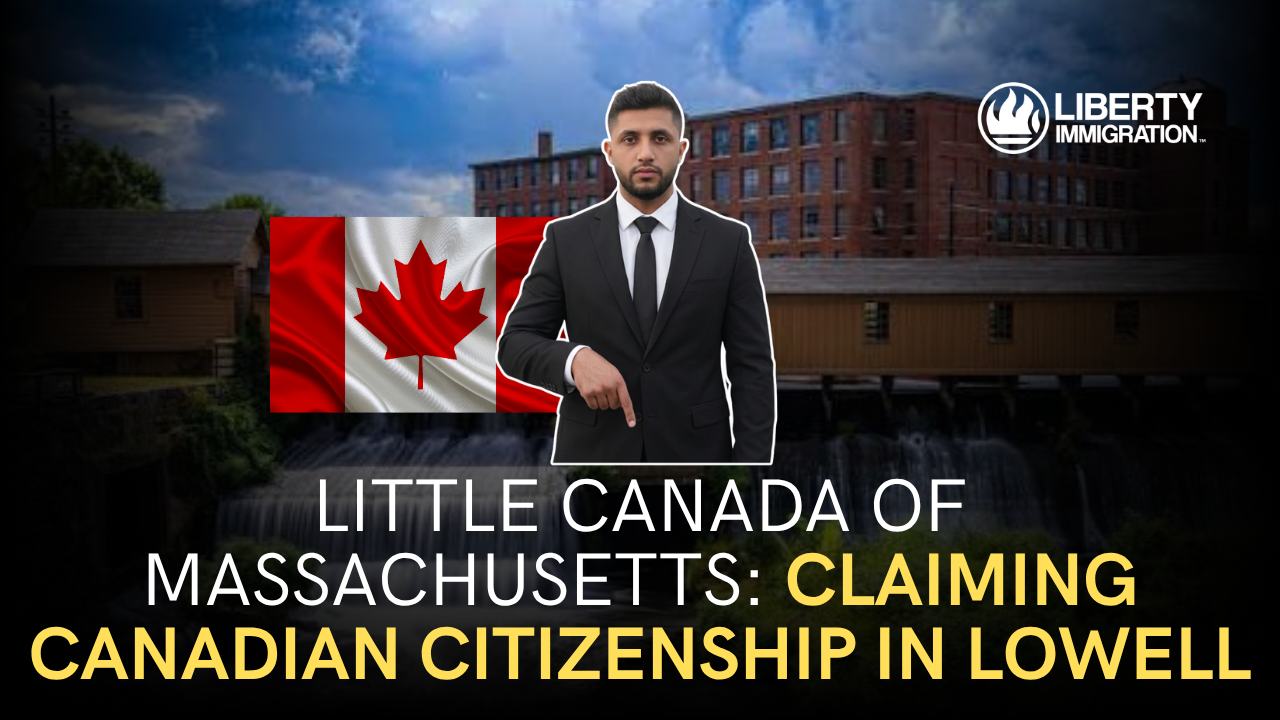
Little Canada of Massachusetts: Claiming Canadian Citizenship in Lowell
📌 Direct Answer: Do Lowell Residents Qualify for Canadian Citizenship?
YES. Thousands of residents across Lowell, Massachusetts, and broader New England qualify for Canadian citizenship by descent under Bill C-3.
If your ancestors migrated from Quebec to work in the Lowell textile mills between 1840 and 1930 ("The Great Hemorrhage"), you are likely already a Canadian citizen by law. Following the enactment of Bill C-3 on December 15, 2025, the First-Generation Limit was permanently struck down for births prior to that date, allowing multi-generational descendants to claim an official Canadian Citizenship Certificate and Canadian passport.
Little Canada of Massachusetts: How Lowell’s History Unlocks Canadian Citizenship for Thousands Today
Between 1860 and 1900, an estimated 31,000 French Canadians migrated from Quebec to Lowell, Massachusetts, seeking employment in the bustling New England textile mills. By 1880, French Canadians comprised the largest ethnic group in Lowell, establishing a vibrant enclave around the Northern Canal known as Le Petit Canada (Little Canada).
This historical migration was part of a larger phenomenon known as "The Great Hemorrhage," during which roughly 900,000 French Canadians left Quebec for industrial New England towns like Lowell, Manchester, Lewiston, and Woonsocket between 1840 and 1930. Today, the American Community Survey estimates that over 202,000 Massachusetts residents explicitly report French-Canadian ancestry—a figure that significantly undercounts the true number of unaware descendants.
Under active Canadian nationality law managed by Immigration, Refugees and Citizenship Canada (IRCC), descendants of these 19th- and 20th-century mill workers hold an immediate birthright claim to Canadian citizenship. Directed by Vineet Tiwari, a licensed Regulated Canadian Immigration Consultant (RCIC # R535983), Liberty Immigration audits historic French-Canadian family trees to convert unregistered ancestral links into official dual nationality.
Trace Your Franco-American Mill Worker Lineage: Schedule an RCIC Audit Today1. The Legal Framework: How Bill C-3 Restored Ancestral Status
Before December 15, 2025, the 2009 First-Generation Limit (FGL) restricted citizenship by descent strictly to children born to a Canadian parent born in Canada. Descendants whose families had lived in the United States for two or three generations were cut off from claiming nationality.
With the enactment of **Bill C-3 on December 15, 2025**, Parliament permanently eliminated the First-Generation Limit for individuals born before that date. Under amended provisions of the Citizenship Act, any individual born outside Canada before December 15, 2025, who can trace an unbroken vertical line back to a Canadian ancestor—regardless of how many generations sit between them—is recognized as a Canadian citizen from birth.
| Historical Generation Node | Lowell Family History Example | Bill C-3 Legal Reality |
|---|---|---|
| Generation Zero (Anchor) | Great-Great-Grandparent born in Quebec (e.g., 1875) | Original Canadian Citizen by birth (*Jus Soli*). |
| Generation One (US Born) | Great-Grandparent born in Lowell, MA (e.g., 1905) | Retroactively recognized as a Canadian citizen at birth. |
| Generation Two (US Born) | Grandparent born in Massachusetts (e.g., 1935) | Retroactively recognized as a Canadian citizen at birth. |
| Generation Three (Applicant) | You (Born in US prior to Dec 15, 2025) | AUTOMATIC CITIZEN: Entitled to Form CIT 0001 Certificate & Passport. |
2. Primary Document Retrieval: Massachusetts & Quebec Repositories
To successfully file a Proof of Canadian Citizenship Certificate application (Form CIT 0001), IRCC requires certified long-form civil records connecting every generation from the Quebec-born anchor down to the applicant.
For Lowell and Massachusetts descendants, civil records are divided across specific governmental repositories:
- Massachusetts Archives (1841–1935): Holds official birth, marriage, and death records for all Massachusetts cities and towns, including recent registry transfers.
- Registry of Vital Records and Statistics (RVRS) (1936–Present): Manages contemporary state civil records for Massachusetts.
- Lowell City Clerk & Local Town Halls: Pre-1936 local birth, marriage, and death records are frequently accessible directly through municipal clerks in Lowell, Lawrence, and Fall River.
- Quebec Civil Registries (DEC & BAnQ): Records created 100+ years ago sit with Bibliothèque et Archives nationales du Québec (BAnQ), while records under 100 years sit with the Directeur de l'état civil (DEC).
IRCC strictly rejects all Quebec church, parish, or baptismal certificates issued prior to January 1, 1994. Applicants relying on Quebec ancestral records must obtain modern certified copies issued directly by the DEC or official certified reproductions from BAnQ. Read our detailed guide on mastering Quebec pre-1994 record rules.
3. Reconciling Anglicized Names & Record Discrepancies
When French-Canadian mill workers settled in Massachusetts, English-speaking clerks and census takers frequently Anglicized or misspelled surnames. For example, Thibodeau became Thibodeaux, Bouchard became Bushey, or Boisvert became Greenwood.
Because IRCC assesses citizenship applications under strict document verification standards, unaddressed name variations will cause an application to be returned. Applicants must reconcile name variations using:
- Civil Marriage & Naturalization Records: Connecting the original French legal name to the Anglicized US variant.
- RCIC Case Cover Letters: A structured legal brief mapping the lineage and explaining historical name shifts. Read our guide on drafting a Canadian citizenship cover letter.
To learn how uncertified records are evaluated by IRCC officers, read proving Canadian citizenship with uncertified family records. If your parent never applied for a passport, consult claiming citizenship when your parent had no Canadian passport.
Secure Your Canadian Citizenship Certificate Under Licensed RCIC Supervision
Proving a multi-generational French-Canadian claim requires precise civil document sourcing across Massachusetts vital statistics and Quebec archives. A single missing long-form birth record or un-bridged surname variation will cause your application package to be returned unprocessed. Let Vineet Tiwari, a fully licensed Regulated Canadian Immigration Consultant (RCIC # R535983), audit your Franco-American family tree, source certified civil records, and manage your Proof of Citizenship submission safely.
Book Your Priority Franco-American Ancestry Audit Session NowFrequently Asked Questions (FAQs)
1. Can I claim Canadian citizenship if my family has lived in Lowell, MA for over 100 years?
Yes. Under Bill C-3, if you were born before December 15, 2025, and can trace an unbroken direct lineage to a Canadian ancestor who migrated from Quebec, you inherit Canadian citizenship regardless of how many decades your family lived in the US.
2. Where do I find vital records for French-Canadian ancestors who lived in Lowell?
Birth, marriage, and death records for 1841–1935 are held by the Massachusetts Archives. Records from 1936 to the present are managed by the Registry of Vital Records and Statistics (RVRS), while pre-1936 town records are available at the Lowell City Clerk’s office.
3. Does claiming Canadian citizenship affect my US citizenship status?
No. Both the United States and Canada fully recognize dual citizenship. Claiming your Canadian citizenship certificate does not impact your US passport or citizenship status.
4. If I qualify under Bill C-3, do my siblings and children qualify as well?
Full biological siblings sharing the same ancestral chain qualify. Children born before December 15, 2025, qualify automatically under Bill C-3 retroactive provisions.
5. How long does IRCC take to process a Proof of Citizenship application in 2026?
Central database processing wait times for a Proof of Canadian Citizenship Certificate (Form CIT 0001) currently average approximately 19 to 25 months.
Related Blogs:


Written By
Vineet Tiwari
Vineet is a caring and creative leader who has lived in India, Oman, UAE, and Canada, giving him a rich multicultural perspective. His commitment to physical fitness keeps him energetic and focused. Vineet's dedication to his clients is evident as he often takes calls on weekends, ensuring they always feel supported and valued. His diverse background and unwavering availability help build strong, trusting relationships with our clients.