
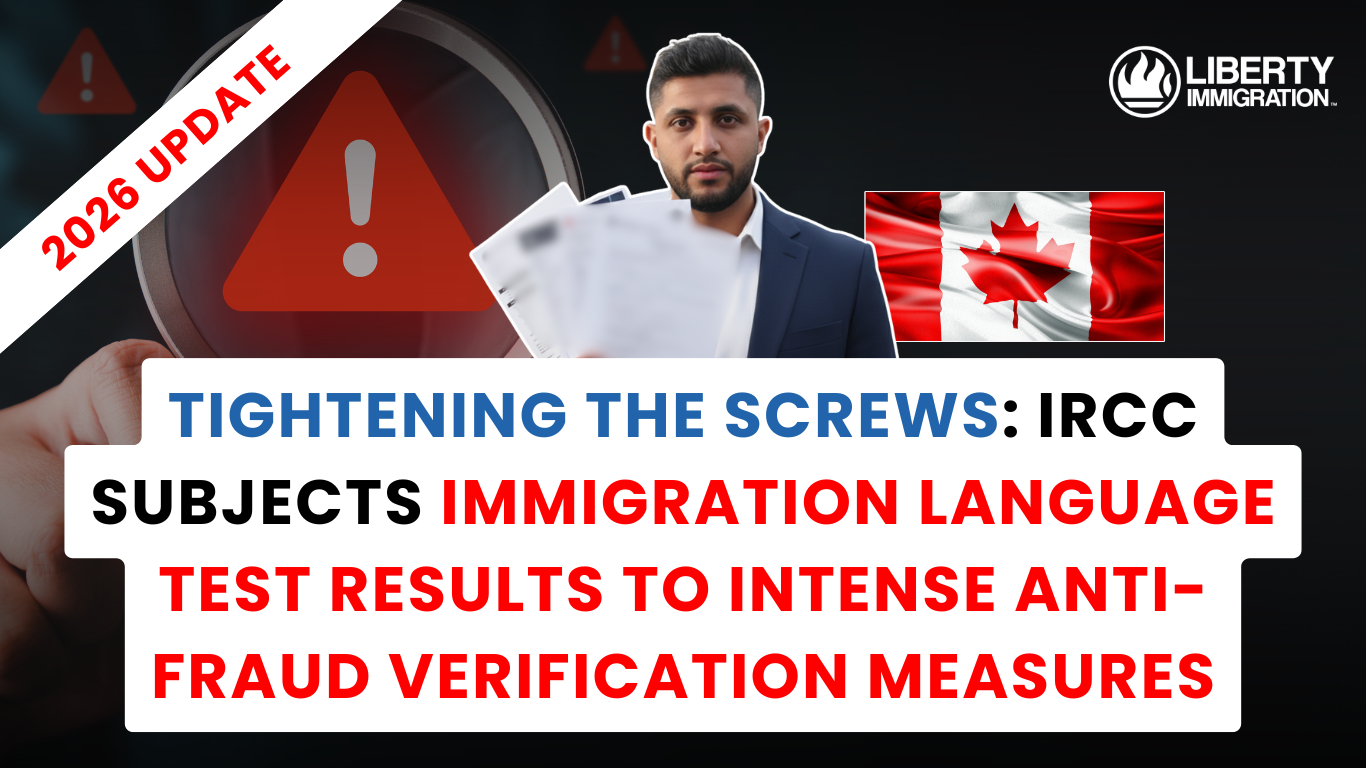
Tightening the Screws: IRCC Subjects Immigration Language Test Results to Intense Anti-Fraud Verification Measures
Executive Summary: The Language Scrutiny Mandate
A major quality-control directive by Immigration, Refugees and Citizenship Canada (IRCC) has completely overhauled the verification pathway for temporary and permanent residency profiles. Published officially on June 23, 2026, the updated internal operational instructions put frontline processing desks on high alert for fraudulent language outcomes. Review the active parameters finalized in this structural upgrade:
- Mandatory Photo Cross-Referencing: Evaluating personnel must systematically cross-check applicant photographs to validate the authenticity of test certificate prints.
- The TMRU Investigation Pipeline: Any suspicious or mismatched score indices must be documented and forwarded directly to the Tips and Reports Management Unit (TMRU) for comprehensive fraud reviews.
- Supervised Retests Phased Out: In a major departure from prior rules, the department has removed the option for applicants to take a second language exam under direct visa office supervision.
- Continuous Stage Verification: Screening desks are instructed to execute these strict validation checks at all stages of application processing prior to making a final decision.
- The Misrepresentation Clause: Portfolios found to rely on manipulated or fraudulent scores will face an immediate application refusal for misrepresentation, subject to procedural fairness thresholds.
Tightening the Screws: IRCC Subjects Immigration Language Test Results to Intense Anti-Fraud Verification Measures
For economic immigration applicants and international student graduates tracking profiles inside Canada's selection pools, demonstrating core language capability is a foundational requirement. Because standardized test results dictate a profile's points ranking and basic eligibility, these documents are highly valued targets for manipulation. To protect the selection system from fraudulent data, the federal government has quietly implemented an aggressive verification framework.
The updated instructions published online on June 23, 2026, alter how immigration officers review incoming test materials. Frontline personnel are no longer permitted to simply accept a submitted certificate at face value; instead, they are mandated to execute deep data checks using photo cross-referencing and targeted system audits. This major change means that generic or unverified submissions will face immediate exposure to specialized federal enforcement units.
As an elite immigration advisory firm directed by Regulated Canadian Immigration Consultants (RCICs), we analyze shifting operational updates to insulate applicant folders from processing gaps. Ensuring a smooth approval requires absolute conformity with the heightened verification tracks now running across all ingestion hubs. This briefing breaks down the mechanics of the photo cross-referencing mandate, changing retest options, standardized benchmark reforms, and the current workarounds applied to post-graduation portals.
Unsure If Your Active Testing Folder Meets Heightened Verification Rules? Schedule a Priority Review Instantly1. The Anti-Fraud Pipeline: Photo Matching and TMRU Escalation
The most important upgrade introduced in the June 2026 instructions is the mandatory use of biometric photo verification. Frontline officers must now cross-reference the physical photograph captured at the third-party testing center against the primary identity documents uploaded inside the applicant's secure IRCC portal account. This check allows officers to rapidly detect instances where a proxy test-taker was hired to sit for the examination.
Additionally, evaluating staff must conduct deep searches of existing case notes and review specialized Info-Alerts issued directly by authorized testing providers to identify suspicious data signals. If an officer flags an unverified score or identifies a potential matching irregularity, they are instructed to document the file and forward the entire portfolio immediately to the **Tips and Reports Management Unit (TMRU)**—IRCC's dedicated internal fraud investigation team. Because these checks run continuously at every single stage of application processing up until the final decision is signed, a profile remains vulnerable to a fraud audit throughout its timeline.
2. Phasing Out Exceptions: Supervised Retests and Misrepresentation Consequences
The updated instructions represent a major departure from past departmental protocols, eliminating historical fallback mechanisms that previously protected applicants from data errors. Under older guidelines, if an immigration officer doubted the validity of a submitted certificate, the visa office routinely offered the applicant an option to clear their profile by taking a second language test under direct government supervision.
The 2026 instructions have **completely removed any mention of supervised second testing**. The department has closed this option entirely, shifting from an educational approach to immediate enforcement. Under the active rules, if a case processing desk reaches a final conclusion of fraud, the application will bypass alternative retesting and face an immediate refusal for misrepresentation under the Immigration and Refugee Protection Act. While these refusals remain bound by procedural fairness requirements—giving the applicant a brief window to respond to a procedural fairness letter—a final finding of misrepresentation triggers a mandatory five-year ban from entering Canada.
3. Standardized Benchmarks: Current Equivalencies and Express Entry Proposals
Canada’s economic selection framework relies on converting third-party test results onto a standardized 12-point national scale: the **Canadian Language Benchmark (CLB)** for English profiles and the **Niveau de compétence linguistique canadien (NCLC)** for French submissions. The table below outlines the core baseline proficiency scores required across various skill categories alongside upcoming selection pool updates:
| Target Occupational Profile Node | Current Mandatory Score Baseline | Proposed Express Entry Selection Reforms |
|---|---|---|
| Management & University Occupations | Minimum Level 7 (CLB 7 / NCLC 7) | Proposed Uniform Floor: Minimum Level 6 Across All Categories |
| Skilled Trades & College Occupations | Minimum Level 5 (CLB 5 / NCLC 5) | |
| High-Scoring Pool Candidates | Awarded significant additional ranking points, vastly increasing selection probability. | |
To successfully log a valid **immigration language test validation canada** profile, applicants must select from five currently authorized third-party testing providers:
- English Options: The Canadian English Language Proficiency Index Program (CELPIP), the International English Language Testing System (IELTS), and the Pearson Test of English (PTE Core).
- French Options: The Test d'Évaluation de Français (TEF) and the Test de Connaissance du Français (TCF).
Sponsoring consulting groups note that while plans were announced last August to introduce the Test of English as a Foreign Language (TOEFL) as an accepted pathway, the active June 2026 guidelines confirm that **the TOEFL platform remains unaccepted at present**. Furthermore, all certificates remain bound by a strict two-year expiration window and must be valid at the exact calendar date that IRCC receives the application.
4. The PGWP Portal Loophole: Upload Overrides and System Gaps
The necessity for absolute documentation accuracy is especially critical for international student graduates. Following expansions enacted in late 2024, candidates seeking a Post-Graduation Work Permit (PGWP)—an open work permit valid for up to three years—must demonstrate mandatory language proficiency linked directly to their specific level of study.
However, an ongoing technical gap inside the government's centralized processing system has introduced a unique challenge for applicants. Due to persistent "system limitations," the online PGWP application portal has not been updated to feature a dedicated, standalone field for entering language test metrics. Although the ministry confirmed in May 2025 that development teams are actively working on building a dedicated input block, no firm implementation date has been shared.
Insulate Your Language Portfolio from Anti-Fraud Audits and Refusals
The implementation of the June 2026 instructions confirms that IRCC has adopted a zero-tolerance policy for language data errors, utilizing photo cross-referencing and immediate TMRU escalations to flag profiles. With supervised second testing eliminated and misrepresentation penalties carrying a 5-year ban, a minor filing mistake can derail your entire Canadian future. Let our elite team of immigration experts perform a forensic audit of your testing records and manage your upload overrides safely.
Book Your Specialized Language Verification Adjudication NowTop 5 FAQs: Surviving IRCC's Language Verification Crackdown
1. How does photo cross-referencing work under the new IRCC instructions?
Immigration officers are now legally required to match the physical photograph captured at the third-party language testing center against the primary identity documents uploaded inside the applicant's portal account to rapidly detect identity fraud or proxy test-takers.
2. Can I request a second supervised language test if my initial results are questioned?
No. The updated 2026 instructions have completely phased out the historical option to take a second language test under visa office supervision. If an officer concludes that fraud has occurred, the application will face an immediate refusal for misrepresentation.
3. Is the TOEFL exam currently accepted for Canadian immigration processing?
No. Although the government announced plans last year to accept the TOEFL exam in the future, the updated internal instructions explicitly confirm that the TOEFL platform is still not being accepted at present. Applicants must utilize CELPIP, IELTS, PTE Core, TEF, or TCF.
4. Where should I upload my mandatory language test results when applying for a PGWP?
Due to ongoing system limitations inside the online portal, there is no dedicated language input field. PGWP applicants must manually upload their official language certificate under the "Client Information" section of their online account to avoid an incomplete file rejection.
5. What are the minimum language scores required under the proposed Express Entry reforms?
While current rules require a minimum level 7 for professional roles and a level 5 for skilled trades, the proposed Express Entry reforms would establish a standardized minimum baseline score of level 6 across all occupational categories.
More Helpful Resources on Portal Verification & Inventory Controls
- The Post-Approval Audit: Understanding Your Rights Under Active Lineage Review Sweeps
- Internal Disclosures: Exposing the Friction Nodes Behind Unexplained Application Backlogs
- The Explanation Brief: How to Correctly Format an Inland Extension Letter of Explanation PDF
- RCIC Strategy Portal: Schedule an Emergency Status Continuity Vetting with Our Expert Team
© 2026 Liberty Immigration. All rights reserved. | Book an RCIC Consultation
Related Blogs:


Written By
Vineet Tiwari
Vineet is a caring and creative leader who has lived in India, Oman, UAE, and Canada, giving him a rich multicultural perspective. His commitment to physical fitness keeps him energetic and focused. Vineet's dedication to his clients is evident as he often takes calls on weekends, ensuring they always feel supported and valued. His diverse background and unwavering availability help build strong, trusting relationships with our clients.