Thinking of Leaving the US? You Might Already Be a Canadian Citizen (2026)


📌 Direct Answer: Could You Already Be a Canadian Citizen?
YES. Millions of American women who are looking for an exit plan from the US are already Canadian citizens today without even realizing it.
Following the enactment of Bill C-3 on December 15, 2025, Canada permanently eliminated the First-Generation Limit (FGL) for anyone born before that date. If you are an American woman born before December 15, 2025, with a Canadian-born or naturalized parent, grandparent, or great-grandparent, you hold automatic Canadian citizenship by statutory law. You don't need a work visa, job offer, or physical residency in Canada—you simply file Form CIT 0001 to claim your official Proof of Canadian Citizenship Certificate and passport.
Executive Summary: Why American Women Are Discovering Their Canadian Citizenship
A recent Gallup study revealed that 40% of American women aged 15–44 want to leave the United States permanently, with Canada ranking as their #1 preferred destination. Driven by growing safety concerns, reproductive rights restrictions, healthcare costs, and workplace burnout, many are discovering that ancestral law already grants them an immediate safety net. Review the key comparison metrics below:
| Key Quality of Life Metric | United States Legal / Social Standard | Canadian Statutory / Social Standard |
|---|---|---|
| Desire to Relocate (Gallup Poll) | 40% of US women aged 15–44 want to leave US permanently. | 11% choose Canada as top destination (outranking NZ, Italy, Japan). |
| Safety & WPS Global Index | Ranked 31st globally on Women, Peace, and Security Index. | Ranked 16th globally; recognized among top safest nations for women. |
| Paid Parental Leave Coverage | 12 weeks unpaid FMLA (for eligible workers); $0 federal paid leave. | Up to 84 weeks combined paid leave via Employment Insurance (EI). |
| Reproductive Autonomy | State-by-state restrictions / bans following Roe v. Wade reversal. | Fully legal, federally protected healthcare access with $0 criminal restrictions. |
| Statutory Paid Vacation Days | 0 mandatory minimum paid vacation days under federal law. | 2 weeks paid vacation minimum guaranteed by federal law (plus statutory holidays). |
| Ancestral Citizenship Depth | Bill C-3 enacted Dec 15, 2025: Unbroken descent through parents, grandparents, great-grandparents. | Zero physical residency, zero exams, zero Canadian tax liability for US residents. |
Thinking of Leaving the US? Thousands of American Women Are Already Canadian Citizens—And Don’t Know It Yet
A quiet demographic movement is taking place across the United States. According to a Gallup survey, a record **40% of American women aged 15 to 44 stated they would move to another country permanently** if given the opportunity. Among all international options, Canada emerged as the single top destination of choice at 11%, outranking New Zealand, Italy, and Japan combined.
What the vast majority of these women do not realize is that they may not need a work visa, employer sponsorship, or permanent resident points to make the move. Following the landmark enactment of **Bill C-3 on December 15, 2025**, millions of Americans carrying Canadian lineage were recognized as automatic Canadian citizens from birth. For **american women canadian citizenship by descent** represents a pre-existing legal right that unlocks dual passport security, universal healthcare, paid parental leave, and complete bodily autonomy.
Directed by Vineet Tiwari, a practicing licensed Regulated Canadian Immigration Consultant (RCIC # R535983), Liberty Immigration audits cross-border family trees to convert unregistered ancestral links into official dual nationality. This comprehensive guide examines the Gallup polling data, details why Canada outranks the US across key social indicators, analyzes Bill C-3 descent provisions, and provides an exhaustive 15-question FAQ covering real-world family concerns.
Tracing Your Ancestry? Schedule an RCIC Citizenship Audit Today1. The Gallup Poll: Why a Record Number of American Women Want Out
The desire among American women to leave the US has quadrupled over the past decade. Gallup’s long-term polling data reveals a direct correlation between political volatility, social polarization, and the impulse to emigrate:
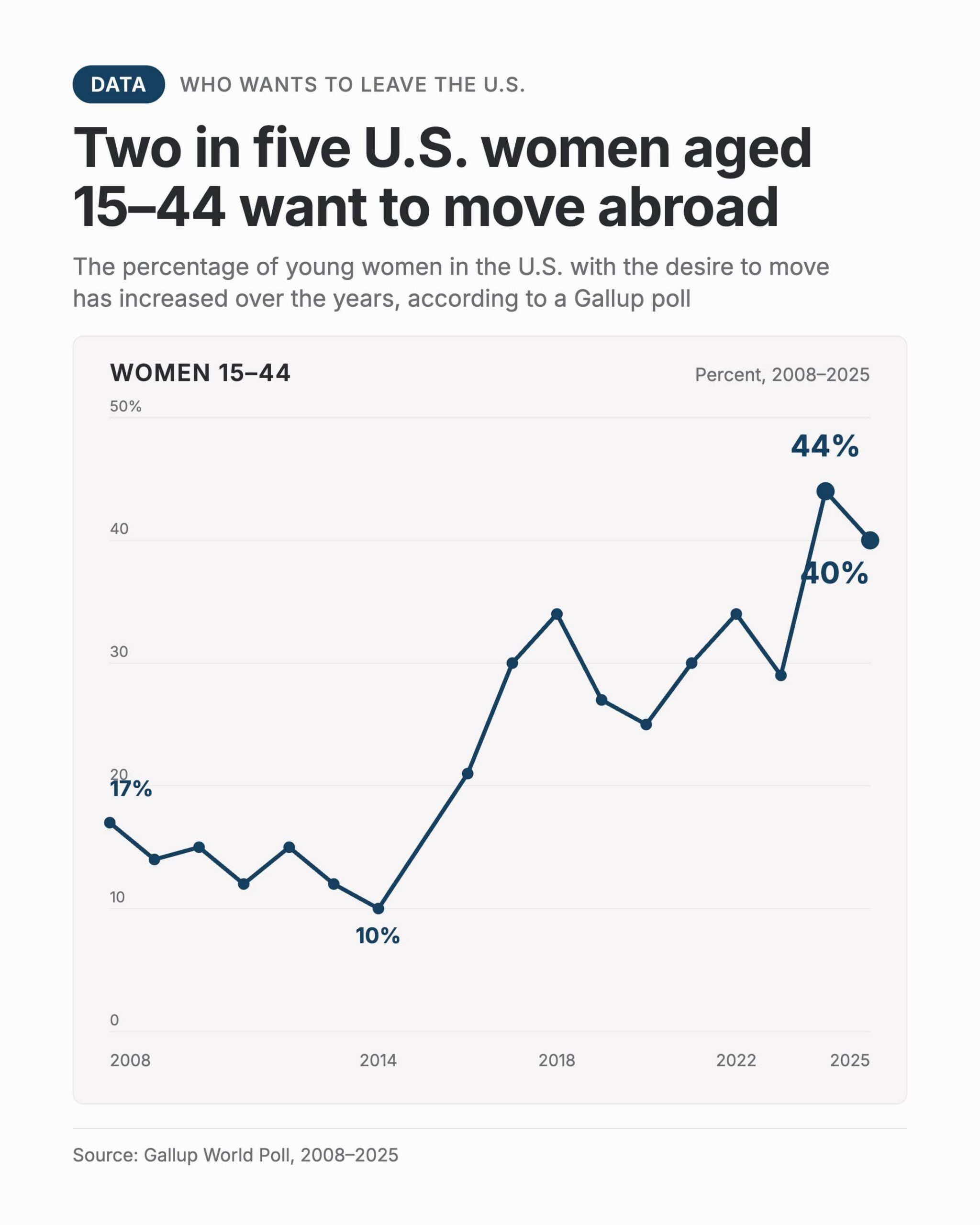
- 2014 Baseline: Just 10% of American women expressed a desire to move abroad permanently.
- 2016 Surge: That figure doubled to 21% during the final year of Barack Obama's administration and the onset of the 2016 presidential election.
- 2025 High Point: Reached an all-time high of **40% among women aged 15–44**, coinciding with the return of the Trump administration.
In qualitative interviews, women cite specific, recurring catalysts driving their desire to relocate: active shooter drills in elementary schools, escalating political hostility, reproductive healthcare bans, discrimination against LGBTQ+ children, prohibitive healthcare costs, and overwhelming workplace burnout.
2. Why Canada Outranks the US for American Women
When American women evaluate alternative countries, Canada consistently emerges as the leading option due to key legal, structural, and social advantages:
A. Safety & Personal Security
On the international **Women, Peace and Security (WPS) Index**, Canada ranks **16th globally**, while the United States sits in **31st place**. The index measures women’s inclusion, justice, and security. Canadian cities consistently report drastically lower violent crime and gun violence rates compared to major US metropolitan areas.
B. Comprehensive Paid Parental Leave
Under Employment Insurance (EI) benefits administered by Employment and Social Development Canada (ESDC), new parents outside Quebec can access **up to 84 weeks of combined paid parental leave** following the birth or adoption of a child. In stark contrast, the US federal FMLA program guarantees only 12 weeks of unpaid leave, leaving millions of working mothers without financial support.
C. Bodily Autonomy & Reproductive Rights
In Canada, abortion is fully legal across every province and territory. Treated strictly as a medical procedure under healthcare law, abortion access is funded through provincial healthcare plans with zero federal criminal restrictions. This stands in sharp contrast to the fragmented US legal landscape following the overturning of Roe v. Wade.
D. Work-Life Balance & Guaranteed Paid Time Off
Federal and provincial laws in Canada enforce mandatory minimum vacation entitlements—guaranteeing **at least two weeks of paid annual vacation** for employees, alongside statutory holidays. Several Canadian jurisdictions have also enacted "right to disconnect" laws restricting after-work employer communications.
E. Civil Rights & Protections for LGBTQ+ Families
Human rights protections covering gender identity and sexual orientation are codified in the Canadian Charter of Rights and Freedoms and every provincial Human Rights Code. For parents of LGBTQ+ youth, Canada provides a legally secure environment free from state-level gender-affirming care bans.
3. The Bill C-3 Revolution: How Unregistered Women Are Already Canadian
For decades, Canadian nationality law enforced a strict "First-Generation Limit" (FGL), which cut off automatic citizenship by descent for children born outside Canada if their Canadian parent was also born abroad. On December 19, 2023, the Ontario Superior Court of Justice declared the FGL unconstitutional in Bjorkquist et al. v. Attorney General of Canada, finding that it created an unconstitutional class of second-generation lost Canadians.
To comply with the court ruling, Parliament enacted **Bill C-3 on December 15, 2025**. Under amended provisions of the Citizenship Act:
If you were born outside Canada prior to December 15, 2025, and can trace an unbroken direct line to a Canadian-born or naturalized ancestor, you are retroactively recognized as a Canadian citizen from birth—regardless of how many generations sit between you and that ancestor.
Whether your Canadian connection is a parent, grandparent, or great-grandparent who moved south from Quebec or Ontario to work in New England's textile mills, you hold a statutory birthright claim to Canadian citizenship today.
4. Tracing Your Ancestry: Clues & Document Sourcing
If you suspect you have Canadian heritage, specific genealogical indicators can help confirm your claim:
- Geography & "Little Canadas": Over 900,000 French Canadians migrated to New England between 1840 and 1930. Concentrated mill towns like **Lowell (MA), Lewiston (ME), Manchester (NH), Woonsocket (RI), and Fall River (MA)** hold deep Canadian civil records. Read our report on how Lowell's history unlocks Canadian citizenship.
- Midwest & Northwest Migration Belts: Families crossing into Michigan, Minnesota, Wisconsin, and Washington State for logging, auto manufacturing, and rail work often left uncollected border records.
- Anglicized Surnames: Surnames were frequently translated at border crossings (e.g., Leblanc $\rightarrow$ White; Boisvert $\rightarrow$ Greenwood; Roy $\rightarrow$ King; Charpentier $\rightarrow$ Carpenter).
To submit a Proof of Citizenship application (Form CIT 0001), IRCC requires certified long-form birth, marriage, and citizenship records for every generation. For detailed rules on document sourcing, explore IRCC's primary vs. secondary citizenship document master list and mastering Quebec's pre-1994 record rules.
5. US Tax Realities & Dual Passport Benefits
A primary concern among American women exploring dual citizenship is whether obtaining a Canadian Citizenship Certificate creates tax obligations or impacts US passport status:
| Cross-Border Parameter | Legal & Financial Reality for US-Based Dual Citizens |
|---|---|
| Canadian Tax Liability | $0 TAX OBLIGATION: Canada taxes based strictly on **residence, not citizenship**. US citizens living in America owe $0 in Canadian tax and file no Canadian returns. |
| Dual Citizenship Legality | Fully permitted by both the United States and Canada. Obtaining a Canadian passport does not endanger US citizenship. |
| Global Youth Mobility (IEC) | Unlocks Working Holiday visas in **36+ countries** (UK for 3 years, France, Germany, Japan, Australia) vs. only 6 countries on a US passport. |
| Application Process | Paper/online submission via Form CIT 0001. No physical presence in Canada required during processing. |
To learn how to structure a submission brief, read our guide on drafting a Canadian citizenship cover letter. You can also explore claiming citizenship across extended American family trees, review Generation Zero naturalized ancestors, or check packaging group family citizenship applications safely.
Claim Your Canadian Citizenship Certificate Under Licensed RCIC Supervision
With official IRCC processing wait times for Proof of Citizenship Certificate applications averaging 19 to 25 months, submitting an incomplete file or un-bridged surname variation carries a two-year delay penalty. Let Vineet Tiwari, a fully licensed Regulated Canadian Immigration Consultant (RCIC # R535983), audit your cross-border family tree, source primary civil records, and manage your Proof of Citizenship submission safely.
Book Your Priority Ancestry Audit Session NowTop 15 Real-World FAQs: American Women & Canadian Citizenship by Descent
1. Can an American woman claim Canadian citizenship through a grandparent or great-grandparent?
Yes. Under Bill C-3 (enacted December 15, 2025), any individual born outside Canada before that date who can trace an unbroken direct lineage to a Canadian-born or naturalized ancestor is recognized as a Canadian citizen from birth, regardless of the number of generations.
2. Will claiming Canadian citizenship force me to pay Canadian income taxes while living in the US?
No. Canada taxes individuals based strictly on physical residence, not citizenship. As long as you reside in the United States, you owe zero Canadian income tax and do not file Canadian tax returns.
3. Do I have to move to Canada or live there for a certain period to get my citizenship certificate?
No. Citizenship by descent is an automatic statutory status. There are no physical residency requirements, language exams, or civics tests required to claim your Proof of Citizenship Certificate (Form CIT 0001).
4. Can I pass Canadian citizenship to my minor children under Bill C-3?
Yes. Any child born outside Canada before December 15, 2025, inherits Canadian citizenship retroactively under Bill C-3 provisions. Children born on or after December 15, 2025, inherit citizenship if their parent meets a 1,095-day physical presence connection test in Canada prior to the child's birth.
5. Can my American husband or spouse get Canadian citizenship through my claim?
No. Citizenship by descent is strictly based on biological bloodline. However, once you receive your Citizenship Certificate, you can sponsor your spouse for Canadian Permanent Residence (PR) under Family Class sponsorship.
6. Does the US government allow Americans to hold dual citizenship with Canada?
Yes. Both the United States and Canada fully recognize dual citizenship. Claiming your Canadian citizenship certificate and passport does not endanger or revoke your US citizenship.
7. What is the difference between a Canadian Citizenship Certificate and a Canadian Passport?
A Citizenship Certificate (Form CIT 0001) is the foundational legal document issued by IRCC proving you hold Canadian citizenship. Once you receive your certificate, you use it to apply for a Canadian passport.
8. What primary documents are required to prove my Canadian ancestral chain?
You must supply certified long-form birth certificates showing parentage for every generation, alongside official naturalization records, marriage certificates (for name reconciliation), and government photo ID.
9. What if my Canadian ancestor's name was misspelled or Anglicized after moving to the US?
Name variations must be formally bridged in your application using certified marriage certificates, legal name-change decrees, or an RCIC-drafted submission brief explaining historical surname transformations.
10. Can I give birth in Canada to ensure my future children receive Canadian citizenship?
Yes. Canada enforces jus soli (birthright citizenship). Any child physically born on Canadian soil automatically becomes a Canadian citizen at birth, regardless of the parents' residency status.
11. How long does IRCC take to process a Proof of Citizenship Certificate application in 2026?
Official central processing wait times for a Proof of Canadian Citizenship Certificate (Form CIT 0001) currently average approximately 19 to 25 months.
12. Can I use a PDF download from Ancestry.com or FamilySearch to prove my Canadian ancestor?
No. IRCC classifies third-party genealogy site downloads as unverified. You must order official, certified civil records directly from the holding provincial vital statistics office or state archive.
13. Does having a Canadian Citizenship Certificate allow me to work in Canada immediately?
Yes. As a Canadian citizen, you have an unrestricted constitutional right to live, work, and study anywhere in Canada without requiring work permits, LMIA approvals, or employer sponsorship.
14. What healthcare rights do dual US-Canadian citizens have when moving to Canada?
Once you establish physical residency in a Canadian province (typically after a 3-month waiting period), you qualify for universal publicly funded healthcare coverage under that province's health insurance plan.
15. Should my family members apply together in one shipment or separately?
Submitting group applications in one package carries a shared risk: if one relative's file is incomplete, IRCC returns the entire package. To apply together safely, each applicant must possess a complete independent file placed in a separate inner envelope.
Essential Resources for Bill C-3 Ancestry Portfolios & Sourcing Proofs
- Franco-American Heritage: How Lowell's History Unlocks Canadian Citizenship
- Extended Family Portfolios: How Canadian Citizenship Reaches Deeper Into US Families
- Group Packaging Guide: Single-Shipment Rejection Risks for Family Applications
- Document Tiers: IRCC Primary vs. Secondary Citizenship Document Master List
- Cover Letter Guide: How to Format Your Canadian Citizenship Cover Letter
Social Share :
Related Blogs: